Roulette online: rules, demo mode, and real money play

Last updated: July 2026 · Written and fact-checked by the PlayWise NZ review desk · Transparency note: PlayWise NZ may earn commission from licensed operators listed in our reviews. This never influences published RTP figures, licensing checks, or withdrawal test results.

“In online casino reviews, marketing promises mean very little next to plain mathematics and verified terms. The PlayWise NZ method follows a strict, repeatable five-step loop: verify the licence, check RNG and live stream integrity, break down bonus terms in plain English, test withdrawals, and evaluate responsible gambling tools. Understanding roulette begins with knowing the exact odds before a single chip goes down.” — Cameron “Cam” Ellery, Senior Casino Reviewer at PlayWise NZ (illustrative editorial persona)


Roulette online rules, demo mode, and

The five things that actually matter

  1. Pick the wheel, not the “system”. European and French roulette carry a 2.70% house edge; American roulette (with 00) doubles that to 5.26%. French tables with La Partage cut the edge on even-money bets to 1.35%, the best mathematical deal in the game.
  2. Every payout is deliberately short of true odds. A straight-up number pays 35:1 but wins 1 in 37 spins. That single gap is the entire house edge, and no bet type on the layout changes it.
  3. No strategy beats the maths. Martingale, Grand Martingale, Fibonacci, D’Alembert, Paroli and James Bond only reshape volatility. Table limits plus a finite bankroll guarantee that negative expectancy eventually wins.
  4. Demo mode teaches rules, not risk. Free-play credits use the same RNG and paytable, but they cannot condition you to real bankroll pressure, and research links simulated play to earlier real-money betting.
  5. Bonuses treat roulette badly. Most welcome offers weight roulette at only 10–20% (sometimes 0%) toward wagering. Live-casino cashback is usually the better fit. Set deposit limits before your first spin.

On this page: formats (demo / real money / live), then rules, table layout and etiquette, bet types and payouts, European, American, French and multiplier variants, live dealer roulette, betting strategies, choosing an NZ-friendly casino with its bonuses and payments, a step-by-step start guide, and the FAQ.

The five things that actually matter

Responsible gambling disclaimer: This guide is general information about game mechanics and probability. It is not financial, legal or clinical advice and does not replace consultation with a qualified professional. Real-money play carries financial risk, and gambling can cause harm. In New Zealand, free confidential support is available through the Gambling Helpline (0800 654 655) or by texting 8006.

What is roulette online and how game formats differ

Roulette online is a digital adaptation of the classic casino game where you bet on where a small ball will land on a rotating numbered wheel. In modern online casinos, roulette arrives through two distinct technical models: software-driven Random Number Generator (RNG) games, and live-streamed dealer games. The core rules, wheel numbers and payout structures stay fundamentally identical across both. What changes is the experience, the pace, and the plumbing behind the scenes.

Virtual RNG roulette relies on audited algorithms to determine where the ball stops on every spin. Live roulette uses a physical wheel, a real croupier, and high-definition camera feeds streamed from a studio. On top of that split, digital casinos offer both non-monetary practice options and cash wagering. Which format suits you depends on one question: are you here for risk-free practice, fast solo play, or a real-time table with people in it?

What is roulette online and how
Technical and operational comparison between RNG Virtual Roulette, Demo Mode, and Live Dealer Streams

Roulette demo: how to play without real money

Roulette demo is a risk-free game format that uses virtual credits instead of real currency, letting you practise chip placement and learn the flow of a round without financial exposure. In demo mode, the software runs the exact same RNG engine and payout table as the paid version in regulated markets, so spin probabilities and outcome distributions are structurally identical. Demo builds are restricted in one important way: they do not process deposits, withdrawals or settled wagers, so nothing you “win” can be cashed out.

Playing a roulette demo lets you test inside bets and outside bets, explore different roulette games such as European or French roulette, and get comfortable with the interface. Practice sessions generate no real-money returns. Academic research on simulated gambling indicates that while free-play modes help with rules, extensive demo play can condition players to the visual rhythm of betting without reflecting the psychological weight of real bankroll management.

Roulette demo how to play without

“Participation in simulated gambling is consistently associated with earlier onset of real-money betting and higher play intensity among young people.” — King et al., systematic review of simulated gambling, Harm Reduction Journal (2018)

Practical note: treat demo mode as a rules laboratory with a hard stop. Use it to memorise chip placement, the dozens and column positions, and the racetrack layout. Then close it. It is not a testing ground for “proving” a betting system, because a few hundred free spins tell you nothing statistically about a game with a fixed 2.70% expectancy.

Roulette real money: what changes when betting with real funds

Roulette real money is the paid format where wagers are debited straight from your casino account balance, and winning outcomes yield cash payouts available for withdrawal. In money roulette, every spin carries a direct financial risk set by the built-in house advantage of the variant you chose.

In a real money roulette game, bet settlement, odds calculation and payout processing are handled automatically by the operator’s gaming engine. Because cash is on the line, bankroll control and risk awareness matter far more than bet selection. A 2024 observational study on player behaviour published in Scientific Reports, which tracked wagering across five online casino product types including roulette, found that players frequently show “within-session chasing”: raising stake sizes or stretching sessions immediately after losses.

Roulette real money what changes when

“Players increase stakes and extend sessions after immediate losses, but shorten sessions as cumulative losses accumulate.” — Observational study of online casino behaviour, Scientific Reports (2024)

Real-money play needs strict deposit limits and session caps set before you enter the lobby. In practice, that means three numbers written down before the first chip lands: total session budget, maximum stake per spin, and a walk-away time. Boring? Yes. It is also the only part of the session you fully control.

Comparison of roulette demo, RNG real money, and live dealer roulette

FormatStake TypeDealer TypeRisk of Cash LossPrimary PurposeTypical RTP / House Edge
Roulette DemoVirtual chips (no value)None (software RNG)None (0%)Learning rules, interface practiceMatches real version (2.70% European)
RNG Real MoneyReal currency (NZD)None (software RNG)Yes (100% of stake at risk)Real-money wagering, solo fast play97.30% RTP (2.70% house edge)
Live RouletteReal currency (NZD)Human live dealerYes (100% of stake at risk)Interactive, land-based casino feel96.30%–97.30% RTP (depending on fees)

Summary: Demo mode exists strictly for risk-free rule learning on virtual credits. RNG real money roulette delivers rapid automated outcomes for cash stakes, while live roulette streams a physical wheel with a human dealer for an authentic casino environment.

Financial risk notice: The information above is general in nature and does not replace professional advice. Real-money betting carries genuine financial risk, and the behaviour patterns described (chasing losses, extending sessions) are common warning signs. If gambling stops being entertainment, contact a support helpline immediately.

Roulette rules: table layout and round sequence

Understanding roulette rules means knowing the precise layout of the roulette wheel, the structure of the roulette table grid, and the chronological order of actions during a spin. The table layout splits into two wagering fields: the central number grid for inside bets, and the surrounding outer boxes for outside bets.

Whether you play in a physical venue or an online casino, every spin is an independent event. Previous results have zero mathematical influence on where the ball lands next.

“Each roulette spin is an independent event with a fixed negative expectation; past results do not influence future outcomes.” — Operator probability guidance for table games (2026)

How the roulette wheel and roulette table are structured

The roulette wheel holds 37 pockets (European/French) or 38 pockets (American), coloured red and black in non-sequential order, with green assigned to zero pockets. The sequence on a European wheel is arranged to distribute high/low and odd/even numbers evenly: 0, 32, 15, 19, 4, 21, 2, 25, 17, 34, 6, 27, 13, 36, 11, 30, 8, 23, 10, 5, 24, 16, 33, 1, 20, 14, 31, 9, 22, 18, 29, 7, 28, 12, 35, 3, 26. Eighteen numbers are red, eighteen are black, and zero is always green.

The roulette table betting grid mirrors these numbers in a 3-column by 12-row layout:

  • Inside Field:Individual numbered squares (1 to 36) plus the top zero section. Chips sit on single numbers, intersecting grid lines, or row borders.
  • Outside Field:Surrounds the number grid with large boxes for group bets: 1st 12, 2nd 12, 3rd 12, 1-18 (Low), 19-36 (High), Red, Black, Even, and Odd.
  • Racetrack (Call Bets):An oval betting layout on many European and French tables, representing the exact physical arrangement of numbers on the wheel. It enables French call bets such as Voisins du Zéro (the 17 numbers neighbouring zero), Tiers du Cylindre (the 12-number third of the wheel opposite zero), Orphelins (the eight “orphan” numbers left over), and Jeu Zéro (zero and its closest neighbours).
Rainbet heading-banner

Table etiquette and non-value chip mechanics

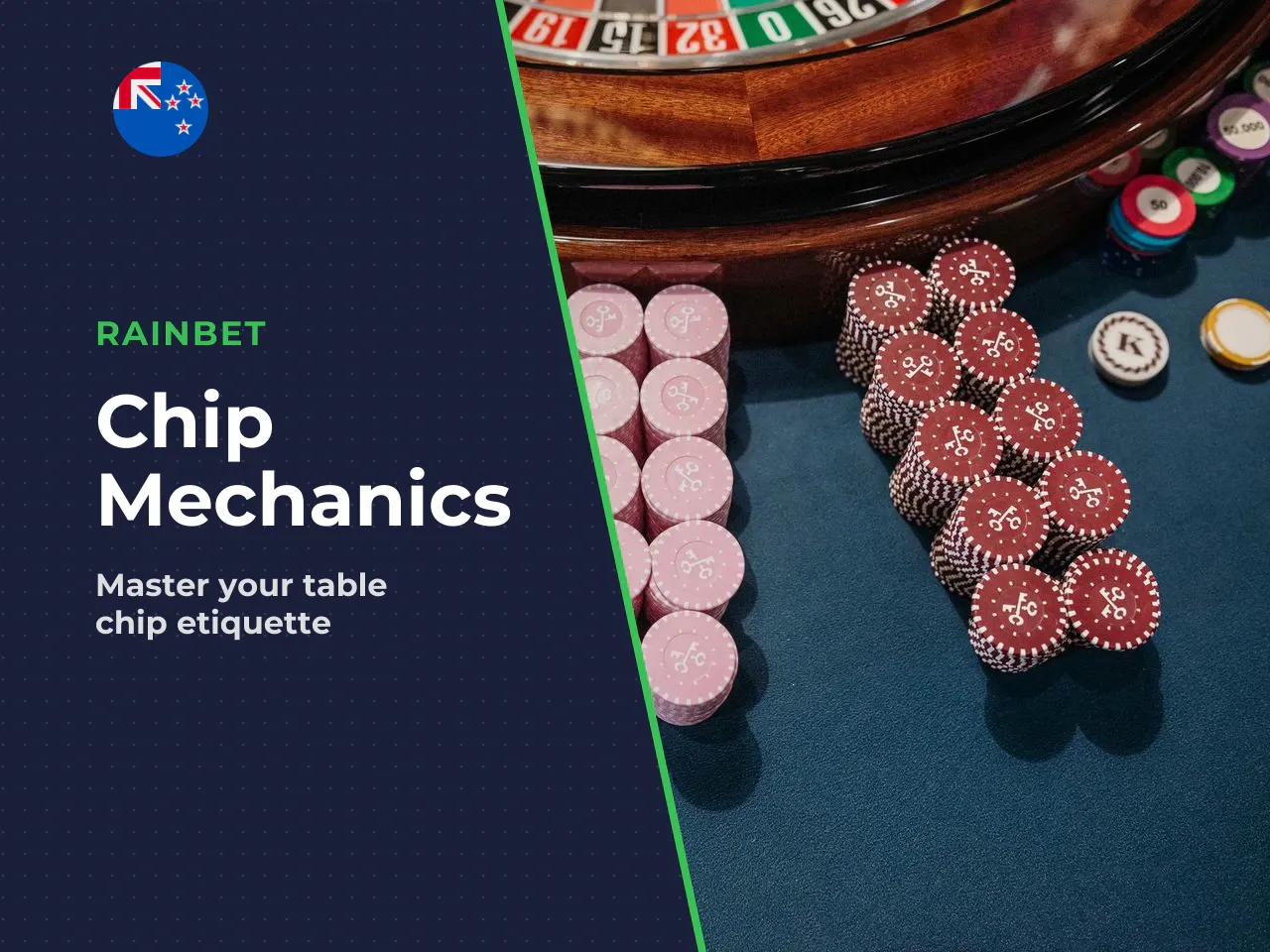
At live-streamed or physical casino roulette, cash chips are exchanged at the table for distinct, coloured “non-value chips”. Each player gets a unique colour, so ownership of complex grid bets can never be disputed, and you set the baseline cash value per chip when you buy in. Because these chips carry no printed denomination, they are worthless anywhere else in the venue. You swap them back for cash chips at the table before leaving, then redeem those at the cashier.

Two further mechanics catch beginners out:

  • Chips only, never cash. Wagers must be placed with chips purchased at the gaming table itself; loose banknotes dropped on the layout are not a valid bet.
  • Critical timing rule. Chips may only be placed while the betting window is open. The moment the live dealer or automated optical system declares “No more bets” (in French, Rien ne va plus), hands come off the grid. Placing, nudging or retrieving chips after that call is a rule violation and invalidates wins for that spin.

In online RNG roulette the software enforces this by simply freezing the layout, but the discipline transfers. Decide your stake before the timer starts, not while it is running down.

Table etiquette and non-value chip mechanics

How a single spin works in roulette

A single spin runs through four sequential steps, from chip placement to final payout:

  1. Chip Allocation: You select chip values and place them on the table layout within the allowed minimum and maximum betting limits.
  2. Spin Initiation: In RNG games, clicking “Spin” freezes chip positions and starts the wheel animation. In live games, the countdown timer reaches zero and the system locks all bets.
  3. Ball Physics / RNG Outcome: The ball travels around the outer rim of the wheel and eventually drops into a pocket. In RNG games, the outcome is generated the moment the spin button is clicked, via a certified random algorithm; in live games, physical friction decides the pocket.
  4. Payout Calculation: The system identifies all winning selections against the paytable, credits your balance with the winnings plus the original winning stake, and clears losing chips from the grid.

Beginner mistakes to avoid: ignoring the placard limits (inside-bet maximums usually sit far lower than outside-bet maximums), chasing losses after a bad run, reading the “previous numbers” board as a prediction tool, and blanketing the whole layout. Cover everything and you will win something on every spin, yet rarely enough to cover the rest of your chips.

How a single spin works in

Types of bets in roulette and payout principles

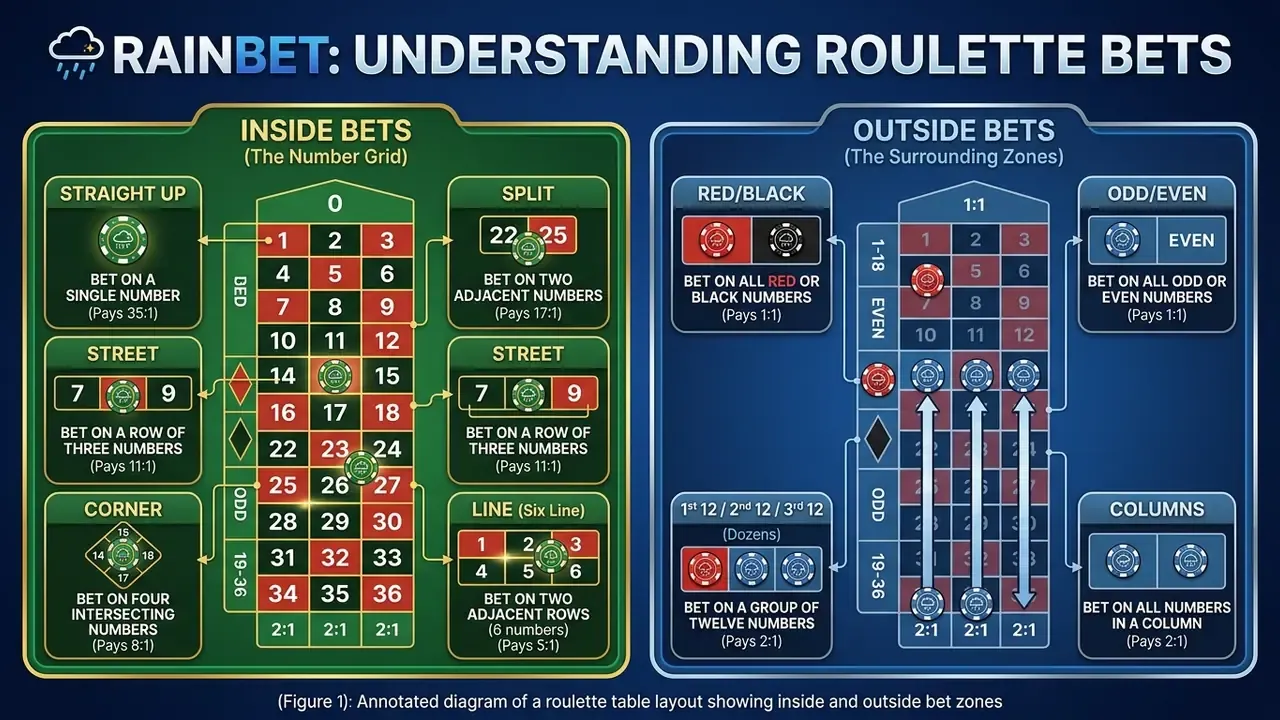
Bets in roulette split into inside bets and outside bets, based on their position on the table layout. Inside bets cover individual numbers or small clusters (1 to 6 numbers), offering high payout multiples alongside lower winning probabilities. Outside bets cover broad categories (12 to 18 numbers), pairing higher win probabilities with lower payout multiples.

The principle governing roulette payouts is an inverse relationship between probability and payout size. As the number of outcomes covered by a single bet rises, the payout multiple falls proportionally.

[📥 DOWNLOADABLE ASSET: “Interactive Online Roulette Betting & Odds Cheat Sheet (PDF)”. Includes a quick payout lookup table for all 11 standard bets, an expected-value chart for European vs American wheels, and a non-progressive stake allocation matrix for NZ$50 / NZ$100 / NZ$250 session budgets.]

Inside bets: betting on numbers and number combinations

Inside bets sit directly on one or more numbers inside the central grid. They suit players comfortable with higher volatility in exchange for larger single-spin payouts:
  • Straight Up (1 Number):Chip on a single number box. Payout: 35:1. Win probability: 2.70% (European) / 2.63% (American).
  • Split (2 Numbers):Chip on the line dividing two adjacent numbers. Payout: 17:1. Win probability: 5.41% (European) / 5.26% (American).
  • Street (3 Numbers):Chip on the outer border of a horizontal row of three numbers. Payout: 11:1. Win probability: 8.11% (European) / 7.89% (American).
  • Corner / Square (4 Numbers):Chip on the intersection where four numbers meet. Payout: 8:1. Win probability: 10.81% (European) / 10.53% (American).
  • Six Line / Double Street (6 Numbers):Chip on the outer border intersection dividing two adjacent three-number rows. Payout: 5:1. Win probability: 16.22% (European) / 15.79% (American).
Inside bets betting on numbers and

On American tables you will also meet two layout-specific wagers: the five-number bet (0, 00, 1, 2, 3) paying 6:1, and the Row 00 bet covering 0 and 00 at 17:1. The five-number bet is the single worst wager in mainstream roulette, at a 7.89% house edge.

Outside bets: betting on outer fields of the roulette table

Outside bets sit on the perimeter of the main grid. They deliver lower variance and are popular for bankroll preservation:
  • Red / Black:Whether the winning number is red or black. Payout: 1:1. Win probability: 48.65% (European) / 47.37% (American).
  • Even / Odd:Whether the winning number is even or odd. Payout: 1:1. Win probability: 48.65% (European) / 47.37% (American).
  • High / Low:Numbers 1–18 (Low) or 19–36 (High). Payout: 1:1. Win probability: 48.65% (European) / 47.37% (American).
  • Dozens (12 Numbers):1st 12 (1–12), 2nd 12 (13–24), or 3rd 12 (25–36). Payout: 2:1. Win probability: 32.43% (European) / 31.58% (American).
  • Columns (12 Numbers):One of the three vertical columns of 12 numbers. Payout: 2:1. Win probability: 32.43% (European) / 31.58% (American).
Outside bets betting on outer fields

Note the zero rule that trips up newcomers. When the ball lands in 0 (or 00), every outside bet loses outright unless the table applies La Partage or En Prison. Only wagers on zero itself, or combinations including zero, get paid.

How bet, odds, and payout are connected

The link between bet size, winning odds and payout is fixed by the house paytable. Expected value ($EV$) per bet is calculated as:

$$EV = (P_{\text{win}} \times \text{Payout Multiple}) - (P_{\text{loss}} \times \text{Stake})$$

For example, a NZ$10 Red bet in European roulette:

  • $P_{\text{win}} = 18/37 \approx 0.4865$
  • $P_{\text{loss}} = 19/37 \approx 0.5135$
  • $EV = (0.4865 \times \text{NZ$10}) - (0.5135 \times \text{NZ$10}) = \text{NZ$4.865} - \text{NZ$5.135} = -\text{NZ$0.27}$

That negative result of −NZ$0.27 per NZ$10 stake is the exact 2.70% house edge. Because inside bets and outside bets sit under the same negative expected value formula, changing your bet selection alters outcome volatility but never the underlying edge. A straight-up number and a red/black bet share identical long-run expectancy. The only difference is how violently your balance swings on the way there.

How bet, odds, and payout are

Types of roulette games: European, American, and French Roulette

The three main variants are European Roulette, American Roulette and French Roulette, separated mainly by wheel construction, zero pockets and house edge. European roulette runs 37 pockets with a single zero, giving a standard house edge of 2.70%. American roulette adds a double zero (00) across 38 pockets, lifting the edge to 5.26%. French roulette uses the single-zero wheel but layers on special rules that can drop the effective edge on even-money bets to 1.35%.

Variant choice directly shapes your long-term expected returns. Independent editorial coverage of iGaming platform integrity makes a useful companion read here, because variant availability and published RTP transparency vary sharply between licensed operators.

For every NZ$100 wagered on a single-zero table, the mathematical expected loss is NZ$2.70. The same stake on a double-zero American wheel carries an expected loss of NZ$5.26. How that number is displayed matters too:

Types of roulette games European, American

“Displaying the house edge (2.7%) instead of RTP (97.3%) reduced the average number of spins played from 19.3 to 15.7 under experimental conditions.” — Study of socio-technical innovations for gambling harm reduction (section 6.3)

Visual comparison of Single-Zero (European/French) vs Double-Zero (American) roulette wheel layouts

European roulette: classic variant with a single zero

European roulette is the global standard for online casino play: a wheel with 37 pockets numbered 1 to 36 plus a single green zero (0). Numbers alternate red and black, and the single zero supplies the house with its baseline statistical advantage.

With 37 total outcomes, a straight-up bet has a winning probability of 1 in 37 (2.70%) yet pays 35:1. That gap between true mathematical odds (36:1) and the payout ratio (35:1) creates the constant 2.70% house edge. Whether you place inside bets on specific numbers or outside bets on red or black, the long-run theoretical return to player (RTP) in European roulette stays fixed at 97.30%.

European roulette classic variant with a

“Regulators require RNGs to undergo independent testing, applying chi-square and Kolmogorov–Smirnov tests to confirm uniform randomness.” — UK Gambling Commission RNG testing and game fairness requirements (section 2.1)

That certification requirement is why a licensed European roulette title cannot quietly run at a worse-than-advertised RTP. The pocket distribution and paytable are locked, tested, and published in the game’s help panel.

American roulette: additional double zero

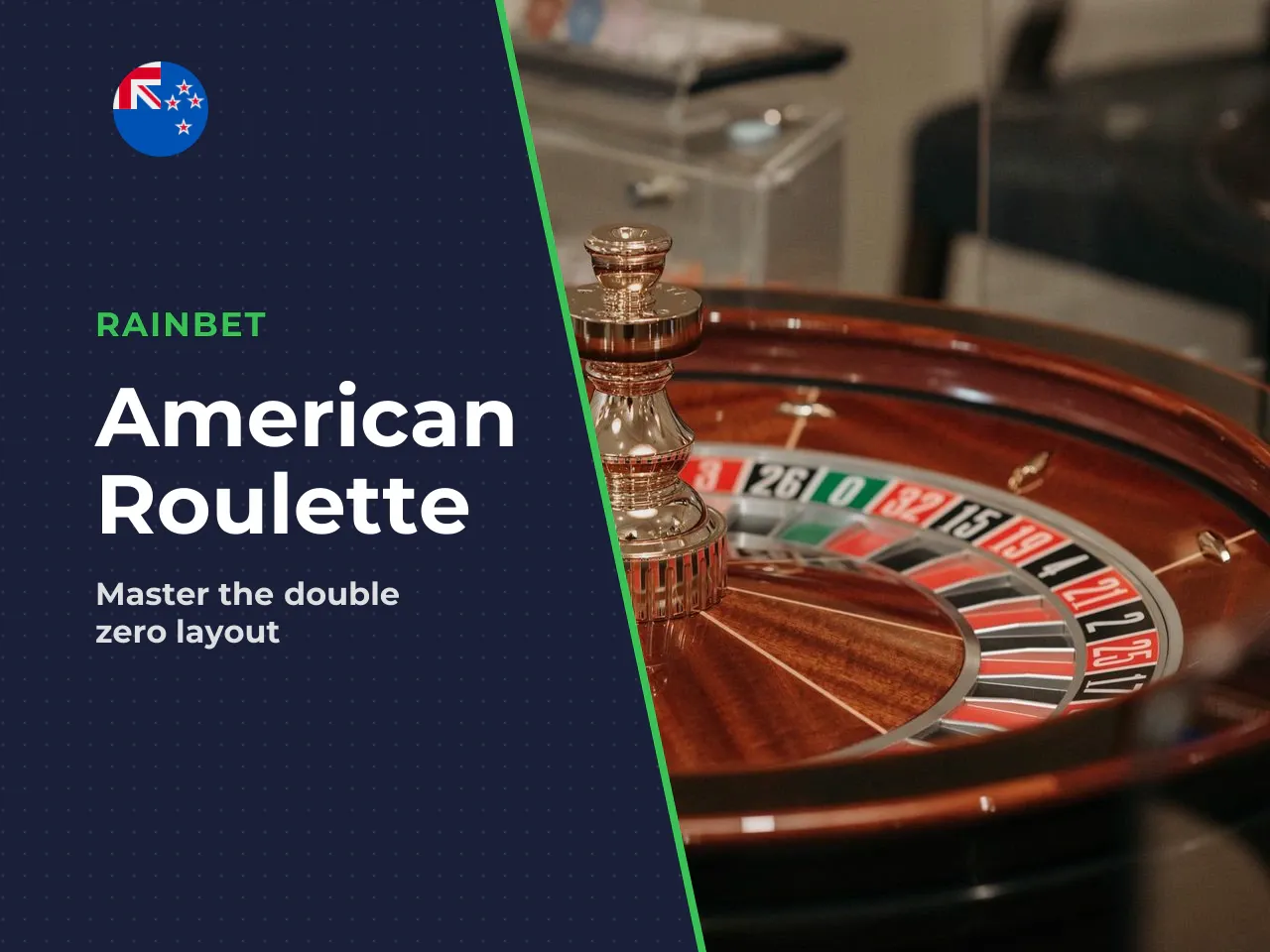
American roulette modifies the classic layout with a second green pocket labelled double zero (00), taking the wheel to 38 pockets. The extra pocket sits directly opposite the single zero, shifting the numerical sequence across the whole wheel.

Adding double zero without any matching increase in payout ratios pushes the house advantage up sharply. A single-number bet on an American wheel still pays 35:1, but the probability of winning drops to 1 in 38 (2.63%). The house edge in American roulette therefore rises to 5.26% across almost all standard bets. American tables also carry the five-number bet (0, 00, 1, 2 and 3), with its exceptionally high 7.89% edge.

Practical takeaway: when both variants sit side by side in a lobby, choosing the American table nearly doubles your theoretical hourly cost for an identical playing experience. Historical prestige (the game’s fame dates back to the Mississippi riverboats) is not a mathematical argument.

American roulette additional double zero. American

French Roulette and other game variants

French Roulette uses the same 37-pocket single-zero wheel as European roulette, then adds beneficial table rules known as La Partage and En Prison. Under La Partage, if the ball lands on zero, players holding even-money outside bets (Red/Black, Odd/Even and so on) receive an immediate 50% refund on their stake. Under En Prison, the stake is held “imprisoned” for the next spin; if that spin wins, the original stake comes back in full. These rules are applied table by table rather than universally, so confirm in the help panel which version is live.

Those rules cut the effective house edge on even-money bets in French Roulette to 1.35%, which makes it mathematically the most favourable variant. Beyond the big three, modern online casinos host alternative roulette games:

French Roulette and other game variants
  • Mini Roulette:A scaled-down wheel of only 13 pockets (0 to 12), producing a higher house edge under standard payout rules.
  • Multi-Ball Roulette:Up to 10 balls spun simultaneously in one wheel, splitting the total stake across multiple active outcomes per spin. Extra balls do not reduce the house edge; they raise hit frequency while payouts shrink proportionally, because each ball settles separately.
  • Multi-Wheel Roulette:A single bet selection evaluated across up to 8 independent European wheels at once. Your stake is duplicated across every active wheel, so an eight-wheel round costs eight times a single-wheel round.
  • Auto Roulette:A live-format table with a physical wheel but no croupier. An air-pressure launcher fires the ball and optical recognition reads the pocket, allowing very high round frequency, which is precisely why stake discipline matters more here.
  • Double Ball Roulette:Two balls, one wheel. Inside bets pay when either ball hits, while outside bets typically require both balls to land in the winning category.
Rainbet heading-banner

Multiplier roulette variants (Lightning & Multifire)

Modern live and RNG roulette games often graft RNG payout multipliers onto a traditional single-zero layout. In variants such as Lightning Roulette (Evolution), Quantum Roulette (Playtech), Power Up Roulette (Pragmatic Play) and Multifire Roulette (Microgaming), between one and five “lucky numbers” receive random multiplier values from 50x up to 500x before each spin. If your straight-up bet matches a struck lucky number, the multiplier replaces the standard payout.

Mathematical trade-off: to fund those elevated payouts, standard non-multiplied straight-up bets are cut from 35:1 down to 29:1 or 30:1. Maximum payout exposure rises dramatically, yet the underlying house edge stays anchored around 2.70% to 2.90%. On some multiplier titles, outside bets are excluded from the multiplier mechanic entirely while still paying only 1:1. Read the paytable before assuming a x500 headline improves your expectancy. It improves variance, not value.

Structural and statistical comparison of roulette variants

Multiplier roulette variants Lightning Multifire
VariantWheel PocketsZero PocketsHouse Edge (Standard)House Edge (Even-Money)Key Table Rule
European Roulette37 (0–36)Single (0)2.70%2.70%Standard payout rules
American Roulette38 (0–36 + 00)Double (0, 00)5.26%5.26%Includes 5-number bet (7.89% edge)
French Roulette37 (0–36)Single (0)2.70%1.35%La Partage / En Prison active
Lightning / Multifire37 (0–36)Single (0)~2.70%–2.90%~2.70%Straight-up cut to 29:1–30:1; 50x–500x lucky numbers
Mini Roulette13 (0–12)Single (0)Higher than 2.70% under standard payoutsVaries by half-back ruleReduced wheel, reduced payout ladder

Summary: European roulette is the reliable baseline at a 2.70% edge. American double-zero wheels lift the edge to 5.26%, which makes them mathematically less favourable. French Roulette gives the best odds on even-money bets, dropping the edge to 1.35% via La Partage, while multiplier variants trade a reduced base payout for high-ceiling volatility.

Live roulette: playing with a live dealer in online casinos

Live roulette blends real-time video streaming, optical camera recognition and physical wheel mechanics to bring a live dealer casino to desktop and mobile screens. Unlike RNG-driven virtual tables, outcomes in live dealer roulette come from a human croupier spinning an official physical wheel in a dedicated studio or on a land-based casino floor.

Leading live casino providers such as Evolution Gaming and Pragmatic Play Live stream rounds in high definition with latency under 200 milliseconds. Optical sensors track the ball’s final pocket position and transmit the winning number to the betting software, which settles every wager instantly.

Live roulette playing with a live

“Average live European roulette RTP sits at approximately 96.30% once studio commissions are included.” — Analysis of live vs RNG RTP based on Malta Gaming Authority statistics (2025), covering 2023–2024 data

That distinction is worth internalising. A live European table is still a single-zero wheel, yet side-bet structures, studio fees and multiplier funding mechanics can shave the effective return below the 97.30% RNG benchmark. Check the specific table’s published RTP rather than assuming parity.

How a round proceeds in roulette live casino

A round in a roulette live casino follows a strict, time-bounded sequence overseen by the live dealer and automated betting timers. Four distinct phases:

  1. Place Your Bets: The dealer opens the wagering window, typically 15 to 20 seconds. Players select virtual chips and tap zones on the digital roulette table overlay.
  2. Bets Are Closed: As the dealer spins the wheel and launches the ball in the opposite direction, the interface shows a “Bets Closed” signal. No further chips can be placed or adjusted for the active round.
  3. The Spin and Settlement: The ball loses momentum and settles into a numbered pocket. Overhead optical cameras scan the result and feed the outcome straight into the gaming software.
How a round proceeds in roulette

“The shift to 4K streaming with sub-200 ms latency has made the gap between the spin and its on-screen display effectively imperceptible for most players.” — Technical review of live and RNG casino games (2025), section 2.4

  1. Winner Announcement: The winning number and colour are called by the dealer and highlighted on screen. Winning bets are credited automatically, lost chips are cleared, and the next betting window opens.

When to choose live roulette over a standard roulette game

Live roulette suits you when visual transparency, real-time interaction and a genuine casino atmosphere matter more than spin speed. Standard RNG roulette games execute instantly at the click of a button, allowing upwards of 100 to 200 spins per hour, which can burn through a bankroll fast if stakes creep upward. (These pace figures reflect observed operator interface behaviour rather than a single published dataset; independent per-title data would strengthen the estimate.)

Live roulette runs at a measured, human-controlled pace, averaging 30 to 45 spins per hour. That slower frequency leaves room to think about your bets and manage the bankroll calmly. Because expected loss scales with total amount wagered rather than time elapsed, halving your spin rate roughly halves your theoretical hourly cost at the same stake. It is one of the very few genuinely mathematical “tactics” available in roulette.

Live games also come with professional croupiers and chat, a social layer that automated RNG software cannot replicate. Choose RNG tables instead when you want the lowest possible minimum stake, offline-friendly loading on mobile data, or the option to open the same variant in demo mode first. Live tables never offer that last one, since studio and dealer costs make free live play commercially impossible.

When to choose live roulette over

Roulette strategy: approaching bets without promises of winning

Disclaimer: This section is general information, not professional advice. No betting strategy removes the casino’s mathematical advantage, and gambling can cause financial harm.

A roulette strategy is a structured method for sizing bets or picking table positions across multiple spins. Betting strategies can help shape session structure and variance, but none can overcome the house edge or guarantee long-term winning outcomes.

In gambling mathematics, roulette spins count as independent trials with a constant negative expected value. Systems that adjust stake sizes based on previous losses or wins merely reframe short-term outcome distributions, leaving the long-term expected loss percentage strictly unchanged.

[⚠️ ALERT BOX: Financial Risk & Strategy Warning.
“There is no roulette strategy that can eliminate the house edge or guarantee profits. All systems are subject to fixed mathematical odds and table limits. Treat roulette strictly as paid entertainment, never as an income source or investment strategy.”]

Interface design can quietly work against your stake discipline as well:

A roulette strategy is a structured

“Sludge — harmful friction in the interface — makes it difficult to reduce stakes, for example by hiding the bet-size control behind several clicks.” — Newall, taxonomy of dark patterns in online gambling (2025), section 6.5

Before committing to any system, locate the stake selector, the “repeat bet” control and the deposit-limit page. If lowering a stake takes more taps than raising one, treat that as a signal about the operator, not about your strategy.

Progressive and non-progressive roulette strategy

Roulette betting strategies fall into two operational categories: progressive and non-progressive.

  • Progressive Strategies: Increase or decrease your stake after every spin depending on whether the previous outcome was a win or a loss. Positive progressions raise stakes after wins to ride streaks; negative progressions raise stakes after losses to recover deficits. Because each stake depends on prior results, exposure per spin can escalate quickly.
  • Non-Progressive Strategies: Keep a constant flat stake on every spin (flat betting), or use predetermined betting layouts that ignore past outcomes. Non-progressive methods give predictable variance and make bankroll tracking simple, though they offer no rapid deficit recovery.
Progressive and non-progressive roulette strategy. Roulette

Martingale, Fibonacci, and other betting strategies

Four of the most widely discussed progressive betting systems in online casino play:

  1. Martingale Strategy (Negative Progression): Double your bet after every loss on an even-money field (NZ$5 → NZ$10 → NZ$20 → NZ$40) and reset to the base bet after a single win. The flaw: a streak of 7 or 8 consecutive losses sends bet sizes skyward, hitting table maximums or draining bankrolls. Starting at NZ$2, eight straight losses run NZ$2 → 4 → 8 → 16 → 32 → 64 → 128 → 256, a NZ$510 drawdown chasing a NZ$2 profit.
  2. Fibonacci Strategy (Negative Progression): Stakes rise along the Fibonacci sequence ($1, 1, 2, 3, 5, 8, 13, 21\dots$) after a loss, then step back two places after a win. It escalates more slowly than Martingale, though long losing streaks still generate severe drawdowns.
  3. D’Alembert Strategy (Equal-Unit Adjustment): Increase your stake by one fixed unit (say NZ$2) after a loss and cut it by one unit after a win. It assumes eventual equilibrium between wins and losses, which is mathematically false thanks to the green zero pocket.
  4. Paroli / Reverse Martingale (Positive Progression): Double your stake after every win for three consecutive wins, then reset to base. Exposure during losing streaks stays limited, but the system relies on frequent win clusters. A typical three-win run at a NZ$1 base returns NZ$7 profit; the reset stops you handing it all back on spin four.
Martingale, Fibonacci, and other betting strategies

Grand Martingale strategy

A high-risk escalation of standard Martingale. After a loss, you double the previous wager and add one extra base unit: lose NZ$5, and the next bet becomes (NZ$5 × 2) + NZ$5 = NZ$15. The appeal is that a single win recovers all prior losses plus a profit equal to one unit per progression step, rather than one unit overall. The cost is brutal. From a NZ$1 base the sequence runs NZ$1 → 3 → 7 → 15 → 31 → 63 → 127 → 255, exhausting a bankroll and colliding with the table maximum roughly twice as fast as standard Martingale.

James Bond strategy (flat combination system)

A non-progressive flat-betting layout covering 25 of the 37 European wheel outcomes, or 67.5% of the table, in a single spin. Using a NZ$200 unit distribution:

  • NZ$140 on High numbers (19–36), payout 1:1
  • NZ$50 on the Six Line (13–18), payout 5:1
  • NZ$10 on green zero (0) as insurance, payout 35:1

The flaw: if the ball lands on 1–12 (12 of 37 outcomes, 32.4% probability), the whole NZ$200 stake goes at once. Covering more of the layout creates no edge, because each component is priced at the same shortfall from true odds. Expected value stays at −2.70% per round. The system simply converts frequent small wins into occasional large losses.

James Bond strategy flat combination system

Why roulette strategy does not guarantee win

No roulette strategy guarantees a win, for three immutable reasons, two mathematical and one operational:

  1. Independent Random Events: The roulette wheel has no memory. The probability of landing on green zero stays 1 in 37 (2.70%) on every spin, no matter whether red has landed 10 times in a row. That misreading is a classic cognitive bias, the Gambler’s Fallacy.

“Any betting strategy in a negative-expectation game forms a supermartingale: its expected value decreases with every spin.” — Study of granular martingales, arXiv (2020), section 7.3

  1. Fixed House Edge: Because payouts (35:1 for single numbers) fall short of true odds (36:1), every unit wagered carries an average expected loss of 2.70%. Adding up multiple negative-EV bets always yields a negative total.
  2. Betting Limits and Finite Bankrolls: Negative progressive systems like Martingale need an infinite bankroll and infinite table limits to guarantee recovery. Real online casinos enforce strict maximum betting limits per table, cutting off doubling chains after a short run of losses. Formally, with a maximum stake $b_{\max}$ and base stake $b_0$, doubling fails once $n > \log_2(b_{\max}/b_0)$ consecutive losses occur, a threshold reached far more often than intuition suggests.

Nor should you assume the standard on-screen warnings will protect you:

2. Fixed House Edge Because payouts

“Participants who saw the slogan ‘When the fun stops, stop’ were 6% more likely to stake all available funds than the control group.” — Randomised online experiment on safer-gambling messaging (section 6.4)

That counterintuitive result is a reminder that pre-commitment tools, meaning hard deposit limits, session timers and self-exclusion, do measurable work that slogans and systems do not.

How to choose a roulette casino and get access to the game

Selecting a reliable roulette casino means verifying regulatory licensing, game fairness certifications, software provider quality and withdrawal processing efficiency. Before registering and depositing real funds, check that the platform operates under a recognised gambling licence and offers robust harm-minimisation tools.

“Voluntary self-exclusion and limit-setting show the strongest evidence base among eight categories of gambling harm-reduction tools.” — Narrative review of harm-reduction tools, 55 studies, 2015–2022 (section 6.3)

In New Zealand, look for operators that demonstrate compliance with local harm-minimisation standards and give transparent access to transaction histories, deposit limits and self-exclusion mechanisms.

Assessing casino transparency involves inspecting the footers of review pages and operator sites for active licensing seals and audit links. For detailed assessments of safe gaming platforms and iGaming standards, independent editorial coverage on iGaming platform integrity offers practical context on regulatory compliance.

Under the Gambling Act 2003, operating an online casino from within New Zealand is illegal, yet the Act does not penalise New Zealand residents for playing on websites hosted and licensed offshore. That is why Kiwi players have historically been served by operators licensed in Malta, Curaçao or the United Kingdom rather than domestically.

The framework has been in transition. Government policy work has moved toward a domestic licensing regime for online casino operators, administered by the Department of Internal Affairs, with a capped number of licences plus mandatory harm-minimisation duties, age verification and advertising restrictions. Commencement dates, licence counts and transitional rules can shift during implementation, so verify current status directly with the Department of Internal Affairs before assuming any specific operator is domestically licensed.

What this means for you in practical terms:

  • Playing roulette on a licensed offshore site is not an offence for the player.
  • Player protection depends entirely on the strength of the operator’s licence, not on New Zealand law, until a domestic licence is confirmed.
  • Winnings from recreational gambling are generally not treated as taxable income for New Zealand individuals. Professional gambling arrangements are a different matter and warrant advice from a tax professional.
Is online roulette legal in New

What to check before choosing a roulette casino

When evaluating an online platform for roulette play, inspect these six criteria:

  1. Licensing & Regulation: Verify a valid licence from an established jurisdiction (Malta Gaming Authority, the UK Gambling Commission, or a New Zealand licence once the domestic regime is live). Licence numbers should be clickable and resolve to an active register entry.
  2. Independent RNG Audits: Look for certification seals from testing laboratories such as eCOGRA, iTech Labs or GLI, confirming that virtual roulette RNG software is genuinely random and unmanipulated.
  3. Tier-1 Software Providers: Check that the game lobby features developers who publish verified RTP data. Evolution dominates live roulette breadth, including Lightning and multi-camera tables. Pragmatic Play runs in-studio promotions and leaderboards on titles like Power Up Roulette. Playtech specialises in variant depth (Grand Roulette, Mini Prestige Roulette) plus lighter, faster-loading live tables.
  4. Payment Methods & NZD Support: Ensure the cashier supports local, secure payment options with transparent processing timeframes and no hidden transaction fees.
  5. Responsible Gambling Tools: Confirm the account dashboard includes self-service tools for daily and weekly deposit limits, session time caps, reality checks and instant self-exclusion, the two measures with the strongest evidence behind them.
  6. Casino Bonus Game Weighting (Wagering Contribution): Standard welcome bonuses are built for pokies first. When claiming a deposit match for roulette, read the terms for the game weighting percentage. Because roulette carries a low house edge (2.70%), operators typically count only 10% to 20% of each roulette wager toward rollover. A NZ$10 roulette bet may contribute just NZ$1.00 toward playthrough, and some operators exclude table games entirely. Watch also for maximum-bet-while-bonus-active clauses and bans on “low-risk” covering bets, such as backing both red and black. Specialised live casino cashback offers (typically 10–20% of weekly net losses, sometimes with zero wagering) and roulette leaderboards usually deliver far better value for a roulette player than a headline slots match.
What to check before choosing a

Deposits, withdrawals and NZD payment methods

New Zealand-facing casinos generally process in NZD to avoid conversion spread. Commonly supported rails include Visa and Mastercard debit, bank transfer, online banking transfers, Apple Pay and Google Pay, e-wallets such as Skrill, Neteller and ecoPayz, prepaid vouchers like Paysafecard, and at some operators crypto rails. E-wallet deposits often start from as little as NZ$10–NZ$20 and credit instantly.

Withdrawal timing is where operators genuinely differ. Based on published cashier terms and documented withdrawal testing, expect:

  • E-wallets:same day to 24 hours after approval, usually the fastest option.
  • Debit card:1–3 business days.
  • Bank transfer:1–5 business days, occasionally longer over weekends.
Rainbet heading-banner

Two frictions to plan for. First, KYC verification: expect to supply photo ID, proof of address and, if you deposited by card, proof of payment method. Submitting those documents at registration rather than at cash-out is the single biggest determinant of a fast first withdrawal. Reputable operators use encrypted upload portals and are obliged under licence to protect that data. If a site asks for documents over email or unencrypted chat, treat it as a red flag. Second, pending or reverse-withdrawal windows: some casinos hold a withdrawal for 24–48 hours, during which you can cancel it back into your balance. Where possible, switch that feature off.

Two frictions to plan for. First

How to start play roulette after choosing a casino

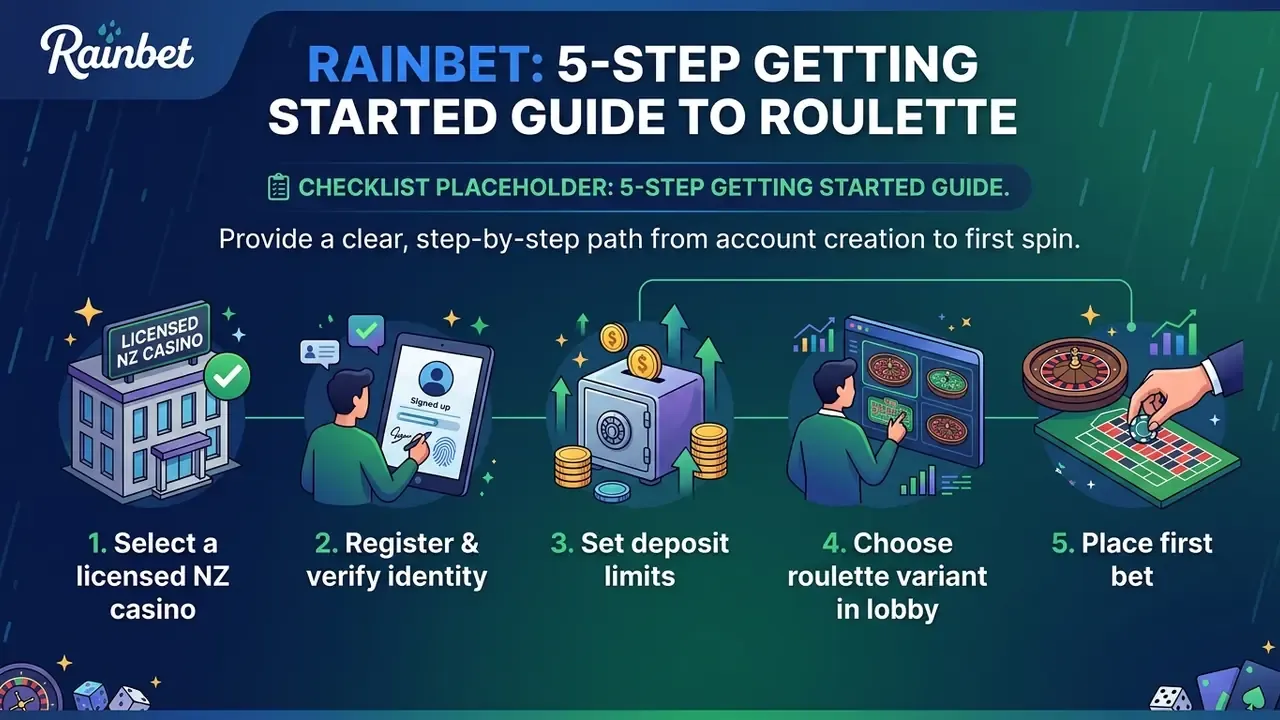
  1. Select a Licensed Casino: Choose an audited operator meeting the security criteria above, and confirm the licence number resolves on the regulator’s public register.
  2. Create and Verify Account: Complete registration with accurate personal details and submit verification documents (KYC) early to keep future withdrawals smooth. Names must match your payment method exactly.
  3. Set Responsible Gambling Limits: Before the first deposit, open the account safety settings and set a daily or monthly deposit limit within your budget. Add a session reminder while you are there.
  4. Explore the Games Library: Filter the casino lobby by “Table Games” or “Live Casino”. Pick European or French Roulette over American Roulette to secure the lower house edge, and check the table placard for minimum and maximum limits that suit your bankroll.
  5. Test in Demo Mode or Place First Bet: Open the game in demo mode first to get used to the chip controls. When you move to real money play, select a small chip denomination, place an outside bet such as Red/Black, and wait for settlement.
1. Select a Licensed Casino Choose

Roulette FAQ

What to do next

  1. Decide your variant on maths, not aesthetics: French with La Partage first, then European.
  2. Write down three numbers, being session budget, max stake per spin and walk-away time, before you open the cashier.
  3. Set a deposit limit and a reality check in the account dashboard as your first action after registration.
  4. Spend 15 minutes in demo mode on the exact table you intend to play, then close it.
  5. Verify your identity immediately, so your first withdrawal is a formality rather than a wait.

If gambling ever stops feeling like paid entertainment, use self-exclusion and contact the New Zealand Gambling Helpline on 0800 654 655 (or text 8006). Support is free, confidential and available 24/7.

What to do next. 1. Decide