Rainbet Plinko: How to Play, Set Your Risk Level and Read the Multiplier

“When evaluating crypto arcade titles like Plinko, transparency in seeds and clear risk framing matter far more than flashy marketing headlines. Players deserve simple maths, verified mechanics, and zero pressure.” Cameron “Cam” Ellery, editorial voice, PlayWise NZ

Last updated: February 2026 · Reviewed by: PlayWise NZ editorial testing desk · Audience: 18+ only

Transparency notice: this guide is written independently. Some outbound links to operators may be commercial partnerships. Commercial arrangements never influence test criteria, ratings, or risk warnings.

Provider

Rainbet Originals

RTP

99.00%

Volatility

High

Min bet

0.10

Max bet

€500.00

Max win

1000x

Rainbet Plinko How to Play, Set

Key takeaways at a glance

  • What it is:Rainbet Plinko is an in-house “Originals” instant-win game. You drop a ball down a pegboard and it settles in a bucket carrying a payout multiplier.
  • Published RTP:approximately 99% (a 1% house edge), which is high by casino standards. It does not protect you from short-run variance.
  • Four controls only:stake (bet), rows slider (8–16), risk level (Low / Medium / High / Rain), and autobet.
  • Multiplier ceiling:up to 1,000x on High risk (16 rows), and up to a cumulative 10,000x in Rain Mode, where a Rain bucket awards a random 2x–100x and then re-drops the ball free of charge.
  • Payments:11+ cryptocurrencies (BTC, ETH, USDT, LTC, SOL, TRX, TON, LINK, XLM, USDC, XRP), plus card purchases via a third-party fiat on-ramp aggregator (Onramper) and redeemable Rainbet Gift Cards.
  • Fairness is checkable:every drop is fixed by HMAC-SHA256 using a server seed, your client seed and a nonce. You can re-compute the exact ball path after the round.
  • Biggest risk:autobet on 16-row High or Rain settings. Set a round cap, a stop-loss and a take-profit before you press start.
  • NZ context:offshore crypto casinos are not licensed to advertise to New Zealanders, and consumer protections differ from domestic operators. Free help: Gambling Helpline NZ 0800 654 655.
Key takeaways at a glance

Why this guide matters if you play from New Zealand

Plinko looks like the simplest game in any crypto lobby. Two clicks, a bouncing ball, a number under a bucket. That simplicity is exactly why it is worth slowing down for.

Three things make it different from a pokie. You choose the volatility yourself. Rounds resolve in seconds, so turnover builds quietly. And the operator behind it sits offshore, outside New Zealand’s licensing perimeter, which changes what happens if a dispute ever lands on your lap.

So this guide does four jobs. It explains the mechanics without hype. It shows the maths behind the multiplier grid in plain English. It sets out payout and verification realities before you deposit. And it keeps limits, stop-losses and support numbers inside the relevant blocks rather than parked at the bottom as an afterthought. That harm-minimisation-first structure is the PlayWise NZ house standard.

Navigating crypto casinos properly requires a clear breakdown of game mechanics, return rates and risk controls before any wager. Rainbet Plinko sits in the “Originals” arcade lobby as an instant-win title inspired by the classic pegboard design, the same ball-drop format popularised by 1980s television game shows before crypto casino operators rebuilt it as a provably fair digital product. With configurable rows, adjustable risk modes and a cryptographic Provably Fair verification system, it advertises a theoretical Return to Player (RTP) of roughly 99% (a 1% house edge) across standard configurations. Behind that high headline sits real variance, and variance is what touches your bankroll.

The PlayWise NZ editorial method focuses on transparent factual analysis: mapping onboarding steps, verifying seed hashes, translating wagering maths into plain English, and embedding harm-minimisation tools into every guide. Below is a full breakdown of how Rainbet Plinko operates, how to configure it, and how to judge its fairness before you play.

Why this guide matters if you

What Rainbet Plinko is and how the game works

Rainbet Plinko is a digital crypto arcade game where a virtual ball drops from the top of a triangular pegboard, bounces off pegs, and settles into a bottom bucket carrying a payout multiplier. The core mechanism is straightforward. Before a drop, you set your stake size, choose the number of pin rows, and pick a risk level. Those three inputs decide how multiplier values are spread across the landing buckets.

How balls distribute across the Rainbet Plinko board

Each round resolves in a few seconds. Observed round timings sit close to two seconds on an 8-row board and nearer four seconds on a 16-row board, depending on animation speed settings, which makes this a genuinely fast-paced instant-win title. (Updated: these timings reflect observed play, not an operator-published specification.) The descent is fixed at the moment of release by a Provably Fair randomisation engine using HMAC-SHA256 over server and client seeds. Every left-or-right deflection on the rainbet pegboard is therefore cryptographically locked, random, and verifiable once the round completes.

Each round resolves in a few

Pegboard, ball and multiplier buckets

The rainbet pegboard is a triangular lattice where pegs increase row by row from top to bottom. When a ball drops from the top centre, it meets a peg at each row and deflects left or right with a theoretical 50/50 chance. For a board of n rows there are exactly n + 1 landing buckets at the base, each representing a cumulative number of rightward deflections from 0 to n.

The likelihood of landing in any particular bucket follows a binomial probability distribution:

“On a 16-row board the outer-edge bucket carries a probability of roughly 0.000015, while the absolute centre bucket is hit around 17.5% of the time.” Independent analysis of crypto-Plinko mechanics, Spindex research report, Section 2.2 (2024)

  • Central buckets: roughly equal numbers of left and right bounces (around n/2). These are the most likely outcomes, near 17.5% for the absolute centre bucket on a 16-row board, and they carry the lowest rainbet multiplier values, often below 1x (such as 0.2x).
  • Outer edge buckets: the ball must bounce almost entirely one way, all left or all right. On a 16-row board that sits near a probability of 0.000015, which is exactly why those slots carry the biggest payouts, reaching 1,000x on standard high-risk settings or a cumulative 10,000x in Rain Mode.

Plain English takeaway: the board is built so the outcomes you see most often return less than your stake. Big multipliers exist precisely because they almost never land.

- Central buckets roughly equal numbers

How Rainbet Plinko differs from other casino games

Plinko occupies an unusual spot in the rainbet casino lobby compared with traditional pokies or crash games.

  1. Direct volatility control. In standard online pokies, volatility is fixed by the software provider. Plinko hands it to you: adjust the rainbet risk level and rainbet rows slider before every single drop.
  2. Transparent multiplier grids. No hidden paylines, no cascading reels, no bonus rounds dressed up as wins. The exact multiplier for every possible outcome is printed under each bucket before you commit a bet.
  3. Lower house edge. Published provider paytables and independent game guides put most online pokies in a 95% to 97% RTP band, a 3% to 5% house edge, and that is worth checking game by game rather than assuming. Rainbet Plinko advertises 99% (a 1% house edge) across its primary risk configurations. That figure appears consistently across independent Rainbet guides in 2026, but it is operator-declared rather than certified in a public third-party audit. Treat it as a claim you can sanity-check yourself with the Provably Fair verifier.
  4. Instant round resolution. A drop settles in seconds, which puts session pacing entirely in your hands. It also removes the natural pauses that normally slow spending down.
  5. Compared with crash games. In crash titles the key decision is when to cash out. Plinko has no cash-out at all. Once the ball is released the outcome is already determined, so strategy is fully front-loaded into stake sizing, rows and risk selection.
How Rainbet Plinko differs from other

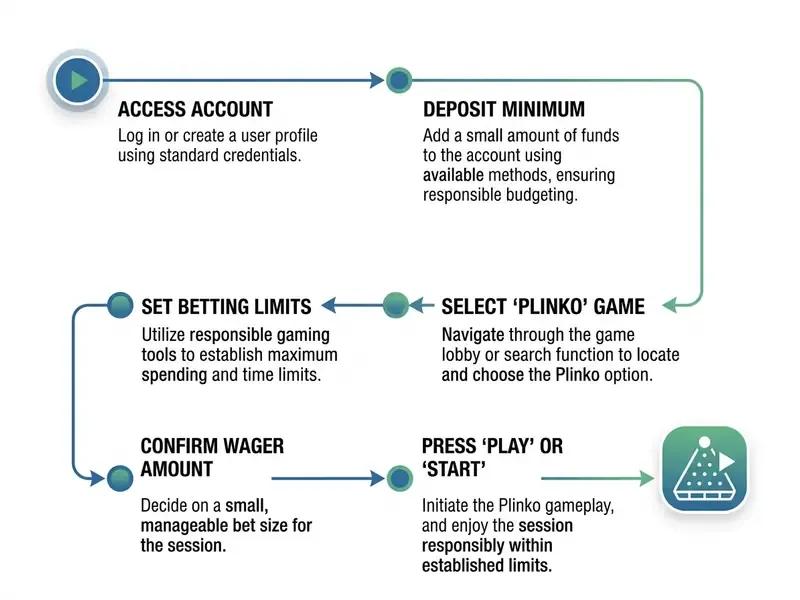
How to access Rainbet Plinko

Getting to the game means a standard account setup, age verification (18+), and funding via a supported method before any real-money betting begins.

  1. Account creation. Visit the official platform, open the registration form, enter a username, a valid email address and a strong password, then verify your contact details.
  2. Identity and safety setup. Review the account safety tools, switch on two-factor authentication (2FA), confirm you are 18 or over, and set personal deposit limits before you fund anything.
  3. Make a deposit. Open the cashier, choose your currency (crypto, a fiat on-ramp gateway, or a gift-card code), copy the deposit address or gateway details, then confirm the transaction.
  4. Navigate the lobby. Open the “Casino” tab, select the “Originals” category, scroll to rainbet plinko and launch it.
  5. Configure parameters. Set your bet size, move the rainbet rows slider (8–16), choose your rainbet risk level, and read the displayed multipliers.
  6. Start play. Click “Drop” (or “Place Bet”) for a single manual round, or configure rainbet autobet to run a controlled sequence with hard limits attached.
1. Account creation. Visit the official

Account, deposit and launching the game

Registration asks for a username and email, a secure password, and agreement to the platform terms. Once signed in, the cashier lets you pick your funding currency. Minimum deposits generally start around the NZD $10 equivalent, though the figure varies by asset and network and can change without notice, so confirm the live minimum in the cashier before you transfer anything. Minimum game stakes sit near 0.10 units, scaling up to roughly 2,000 units per drop.

Cashier policy checks in the PlayWise NZ method always run the full deposit-to-cashout loop, because payout speed and verification delays tell you more than any promo page. A standard check looks like this: fund the NZD $50 equivalent, complete the KYC identity check, then request a withdrawal. Where documents are confirmed up front, the payout clears cleanly. Where they are not, that is almost always where the “slow withdrawal” complaints come from. Plain English takeaway: transparent verification early prevents stressful cashout delays later. For more on how independent testing works across iGaming platforms, see the guide on iGaming platform standards.

Account, deposit and launching the game

Rainbet crypto support and access via the Rainbet app

As a crypto-native casino, Rainbet supports a broad set of digital assets for near-instant deposits and withdrawals, with no internal processing fee charged by the operator. Supported tokens include Bitcoin (BTC), Ethereum (ETH), Tether (USDT), Litecoin (LTC), Solana (SOL), Tron (TRX), Toncoin (TON), Chainlink (LINK), Stellar (XLM), USD Coin (USDC) and Ripple (XRP). Players without an existing crypto balance can use integrated third-party fiat-to-crypto gateway aggregators such as Onramper, which allows direct purchases with credit or debit cards, alongside redeemable 16-digit Rainbet Gift Cards bought in-app or entered as a code. Your balance is usually shown in a fiat equivalent based on your region, which makes stake sizing in NZD terms much easier to track than raw token amounts.

On-chain analytics platforms tracking casino hot wallets in 2026 show Rainbet operating across four networks, Ethereum, Solana, Tron and BNB Chain, with stablecoins accounting for roughly two-thirds of tracked balances. Practical takeaway: stablecoins (USDT, USDC) strip exchange-rate drift out of your bankroll maths, while Solana and Tron usually settle with the lowest network fees.

Using rainbet crypto for deposits gives you fast processing and lower fees, which suits an arcade game where you might place dozens of rounds a minute. One warning worth repeating. Always check that the network selected in the cashier matches the network you are sending from. Mismatched networks are the single most common cause of lost deposits at crypto casinos.

There is no standalone native application in the mobile app stores. Mobile access runs through a fully responsive web application, the rainbet app interface, which mirrors desktop functionality. On a phone or tablet you can still move the rainbet rows slider, change the rainbet risk level, watch the rainbet multiplier grid update, and run rainbet autobet routines. Adding the site to your home screen gives an app-like launch without installing anything.


Rainbet crypto support and access via

Withdrawal speeds, limits and fees

Cash-out mechanics matter more to most players than any promotional headline. The table below sets out what to expect, based on the PlayWise NZ payout checklist and publicly reported operator behaviour through 2026. Figures are indicative, so confirm them in the cashier before requesting a payout.

Indicative Rainbet withdrawal profile by method (2026)

MethodTypical minimumTypical processing timeOperator feeNotes
Stablecoins (USDT / USDC)~NZD $10–20 equivalentMinutes once approved (commonly reported near 5 minutes)None from the operatorNetwork gas applies; TRON and Solana rails are cheapest
Bitcoin (BTC) / Litecoin (LTC)Asset-dependentMinutes to about 1 hour (block confirmations)None from the operatorBTC network fees fluctuate with congestion
Ethereum (ETH) / LINKAsset-dependentMinutes, subject to gasNone from the operatorGas can be material on small withdrawals
SOL / TRX / TON / XLM / XRPAsset-dependent, lowUsually under 10 minutesNone from the operatorLowest-cost networks for frequent small cash-outs
Fiat card cash-outNot supported directlyn/aThird-party spread appliesWithdraw in crypto, then off-ramp via an exchange

Three practical rules from the payout checklist:

  • Complete KYC before you win, not after. Verification requests are the main cause of “delayed” payouts, and they trigger on withdrawal thresholds, not deposits.
  • Withdraw to a wallet you control, on the same network you deposited from. Cross-network mistakes are irreversible.
  • Batch small wins. On high-gas networks, frequent micro-withdrawals erode more value than a zero-fee policy saves you.

New Zealand’s online gambling framework draws a sharp line between domestic and offshore operators. Under the Gambling Act framework, New Zealand-based operators cannot offer online casino gaming to residents outside tightly defined channels, while it is not an offence for an individual New Zealander to place a bet with an overseas-based website. What is restricted is offshore operators advertising or promoting to New Zealanders. Reforms progressing through 2025 and 2026 introduce a licensing regime for online casino operators serving this market, plus advertising rules, harm-minimisation duties and enforcement powers.

What that means in practice:

  • Rainbet is an offshore, crypto-first operator. It is not a New Zealand-licensed gambling provider; it holds an overseas licence instead.
  • Your consumer protections differ. Disputes are resolved under the operator’s licensing jurisdiction, not under New Zealand gambling or consumer regulation. There is no NZ-based dispute body for offshore casino play.
  • Provably Fair is a technical safeguard, not a regulatory one. Verifiable seeds prove a round was not manipulated. They do not guarantee payout, account access, or a fair dispute outcome.
  • Check the current position before depositing. Licensing status and permitted market access can shift as the 2026 regime is implemented, so confirm the operator’s standing and your own obligations.
  • Tax: casual gambling winnings are generally not treated as taxable income for New Zealand individuals, though professional-scale activity can be assessed differently. Get independent advice if that might apply to you.
Is Rainbet legal and safe for

Rainbet Plinko settings: bet, rows slider and multiplier

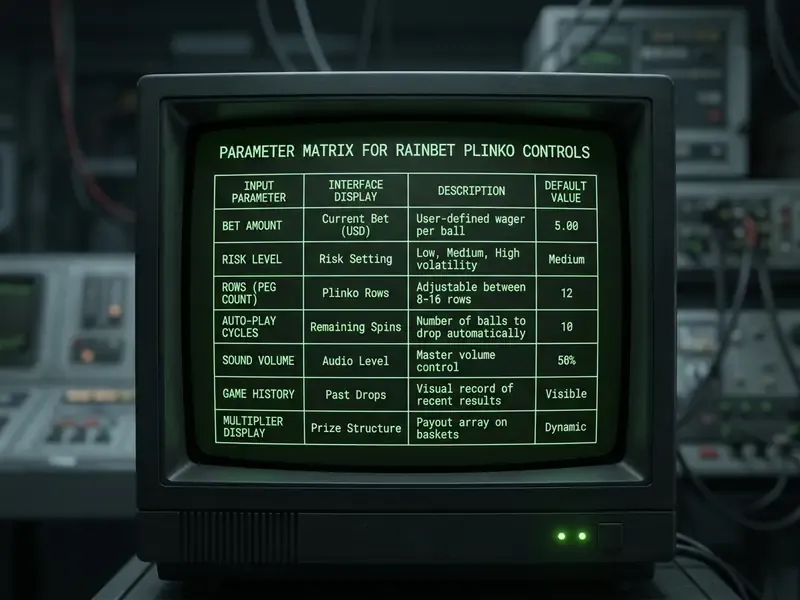
Before dropping a ball you configure four parameters that govern your wager, the board geometry, and the payout scale on offer. Understanding these controls prevents accidental over-exposure and keeps a session inside your planned budget.

Configuration parameters and player-facing displays in Rainbet Plinko

ParameterWhat it changesWhat is displayed to the player
Bet (stake size)Sets the amount wagered per ball drop, scaling absolute payouts linearly.Current stake in your chosen currency (NZD or crypto equivalent) and absolute potential returns.
Rows sliderAdjusts peg rows from 8 to 16, changing the number of landing buckets and the probability curve.Pegboard lattice height and the updated count of landing slots at the base (n + 1).
Risk levelRedistributes payout values across the buckets (Low, Medium, High, Rain), altering volatility.Colour-coded multiplier scale under the buckets, plus the maximum multiplier target (16x, 1,000x, 10,000x).
Multiplier displayDefines the payout coefficient applied to your stake for each specific bucket.Numeric values below every landing slot, for example 0.2x in the centre up to 1,000x on the outer edges.
Autobet controlsAutomates repeated drops using round counts, stop-loss limits and profit targets.Active auto-run indicator, remaining round counter, stop-loss thresholds and cumulative session profit or loss.

Multiplier and range matrix (16 rows)

Multiplier ceilings are always quoted at maximum board height, so the cleanest comparison is a single matrix. Every value below assumes the 16-row configuration. Reducing rows compresses both ends of the scale.

Rainbet Plinko multiplier and range matrix (16 rows)

Risk levelMin multiplier (centre)Max multiplier (edges)Special features
Low0.5x16xHigh hit frequency, minimum variance
Medium0.3x110xBalanced bankroll retention
High0.2x1,000xHigh volatility, steep central penalty
Rain Mode0.2x500x base bucket, up to 10,000x cumulativeFree re-drops with random 2x–100x bucket multipliers

How the rows slider works

The rainbet rows slider sets board height between 8 and 16 rows, and that directly reshapes the binomial distribution.

  • 8 rows (9 landing slots). A compact triangle with a short path, roughly two seconds. The central bucket keeps a relatively healthy multiplier, about 0.5x to 1x depending on risk, while edge buckets top out lower, near 29x on High risk. Edge hits arrive far more often, around a 0.39% chance per edge.
  • 12 rows (13 landing slots). The middle ground most players settle on. Mid-tier multipliers become reachable, roughly 11x to 33x on Medium, while central losses stay moderate.
  • 16 rows (17 landing slots). A taller pyramid with a longer descent, close to four seconds. Central buckets fall to low factors such as 0.2x, while outer edges scale hard to 1,000x, or a cumulative 10,000x in Rain Mode. Reaching an extreme 16-row edge bucket needs 16 consecutive deflections the same way, a probability near 0.0015%.

Quick maths: more rows widens the range of outcomes and raises volatility, but it does not touch the theoretical 99% RTP. You are redistributing the same expected return across a wider, spikier curve. Nothing more.

How the rows slider works. The

How to read the multiplier before and after a round

Reading the rainbet multiplier layout before clicking “Drop” is basic bankroll management.

How central and edge bucket values shift with risk level
  1. Pre-round inspection. Look at the bottom row and note the central values. On High risk with 16 rows, central buckets read 0.2x. An NZD $10 stake landing there returns NZD $2, a net loss of $8. Outer buckets escalate through values such as 26x, 130x and 1,000x.
  2. Post-round settlement. When the ball lands, that slot highlights and the gross return is calculated as stake × multiplier. A NZD $5 stake landing in a 130x bucket pays NZD $650.
  3. A structural point worth pausing on. Because the lowest buckets still return 0.2x to 0.5x, you never lose 100% of a single stake. You also cannot cash out mid-round. A run of 0.2x results is functionally an 80% loss per drop, and it compounds much faster than most players expect.
1. Pre-round inspection. Look at the

Rainbet risk level: what the risk setting actually changes

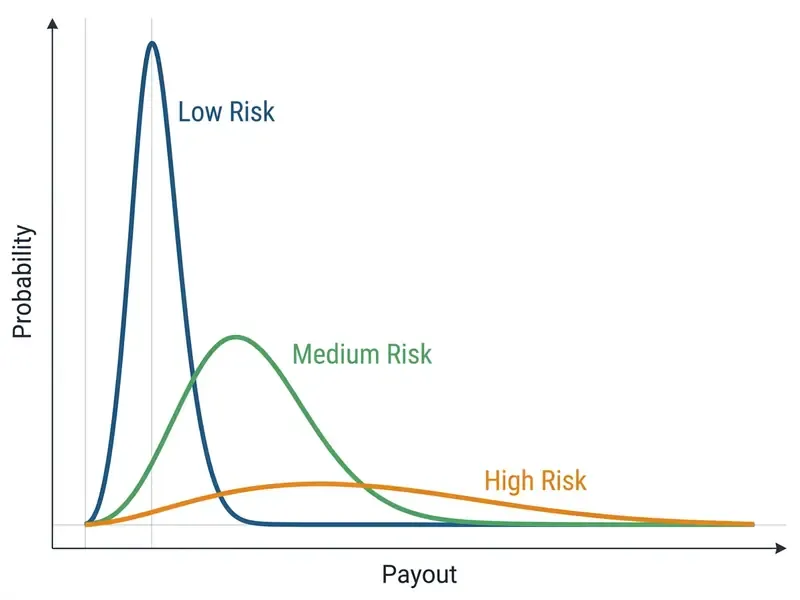
The rainbet risk level controls how payout value is distributed across the buckets. It does not change the theoretical house edge. Raising the risk level simply moves financial value from the centre of the board out to the edges.

Outcome dispersion by risk level

Low, medium, high and Rain risk in Plinko

  • Low risk. A relatively flat payout curve. On a 16-row board, central buckets pay around 0.5x to 1x, and edges peak modestly near 16x. Lower volatility, more session minutes, steadier bankroll.
  • Medium risk. A balanced spread. Centre near 0.3x, inner-middle buckets returning 1.5x to 3x, outer edges reaching 33x to 110x.
  • High risk. A high-volatility profile. Central buckets drop to 0.2x, an 80% loss on a central hit, with value concentrated into the far edges at 1,000x. Expect frequent partial losses broken up by rare, significant wins.
  • Rain Mode. Ultra-high volatility that stretches the maximum to a cumulative 10,000x on 16 rows, funded by pushing the central buckets even lower.
Low, medium, high and Rain risk

Rain Mode mechanics, step by step

Selecting the “Rain” risk level activates specialised buckets at the base of the 16-row pegboard, typically two designated Rain spots. When a ball enters a Rain bucket, it triggers an immediate random reward between 2x and 100x. The round does not end there. The ball is automatically re-dropped from the top of the pegboard at zero additional wager cost, a $0 re-drop. That secondary drop lets multipliers compound in sequence, which is how the theoretical 10,000x cap becomes reachable at all.

In plain English: Rain Mode turns one paid drop into a possible chain of free drops, and it pays for that upside by dragging the standard base buckets down to 0.2x. The 10,000x figure is a cumulative ceiling reached only by stacking consecutive Rain hits, not a single-bucket value. The base Rain grid itself tops out near 500x.

Rain Mode mechanics, step by step

How to combine risk level and rows slider

Pairing the rainbet risk level with the rainbet rows slider produces distinct profiles for different bankrolls and temperaments.

  1. Bankroll preservation profile (8 rows + Low risk). Low variance. Maximum multiplier is modest, roughly 5.6x, but central hits return most of your stake. Sensible for beginners and small budgets.
  2. Balanced arcade profile (12 rows + Medium risk). Moderate variance, with a workable mix of mid-tier multipliers around 11x to 33x at reasonable hit frequencies.
  3. High-volatility moonshot profile (16 rows + High or Rain risk). Extreme variance. Needs a large cushion to absorb long losing streaks, where more than 70% of drops can return 0.2x, while you chase rare 1,000x-plus edge buckets.

Volatility is not a cosmetic preference. It measurably changes how much money leaves your account:

How to combine risk level and

“A one-standard-deviation reduction in volatility from the average player was associated with roughly an 11% decrease in daily losses.” Panel regression study of 4,281 online slots players, UK operators (2021)

Translated for Plinko: if you want more entertainment minutes per dollar, lower risk and fewer rows will do more for you than any staking pattern ever will.

Rainbet autobet: automated betting in Plinko

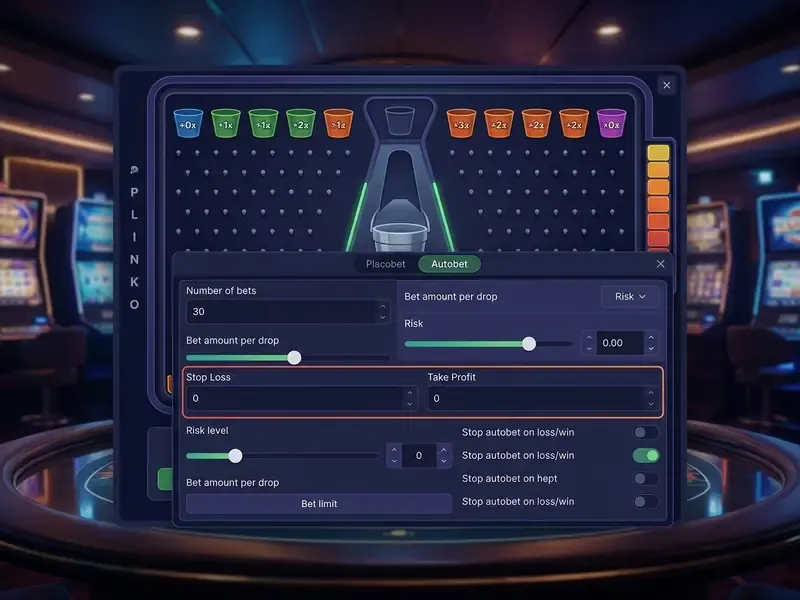
The rainbet autobet function runs continuous drops without manual clicking. Convenient, certainly. It also removes the friction of starting each round, which can accelerate bankroll drawdown badly during an adverse streak. A worked example: a $5 stake with autobet set to 100 rounds commits $500 of total turnover before you make a single further decision.

Setting up autobet limits and stop-loss thresholds

Parameters to check before enabling autobet

Treat this as a pre-flight check, and run it every time.

  • Single bet size. Keep your stake per drop to a safe slice of your session budget, ideally no more than 1% to 2%.
  • Risk level and rows slider. Confirm both are set deliberately. Automated drops on 16-row High risk without a loss cap can empty a balance in minutes.
  • Number of auto-drops. Set a finite round limit, say 10, 50 or 100, rather than letting it run open-ended.
  • Stop-loss limit. Program a hard cap, for example stop autoplay if the balance falls by NZD $30.
  • Take-profit target. Set a ceiling too, such as stopping when the balance rises by NZD $50, so gains actually get locked in.
  • Dynamic stake adjustments. Rules like “increase bet by X% on loss” or “reset to base stake on win” belong only in a plan you genuinely intend to follow. Progression systems increase exposure without shifting the 1% house edge. Used deliberately, they execute your plan without emotion. Used casually, they are the quickest route to a wiped balance.
  • Multi-ball and speed settings. Some Plinko builds allow simultaneous balls or a fast-drop toggle. Each ball is a separate wager, so multi-ball multiplies turnover per click. Count balls, not clicks.
  • Session clock. Set a timer outside the game. Autobet removes the natural pauses that normally prompt you to stop.

Research on automated play features backs this up:

Parameters to check before enabling autobet

“Introducing autoplay increased total staked volume by 6.9% to 9.1% per session, with no significant change in players’ net losses.” Jonsson et al., interrupted time-series study on casino autoplay features (2024)

Plain English takeaway: autoplay makes you place more bets faster without improving your odds. Set the stop-loss before you hit start.

Disclaimer: this information is general in nature and does not replace professional advice. Automated betting can accelerate the loss of funds. Set your limits before you begin playing.

Rainbet demo Plinko: trying the game for free

Testing mechanics in a risk-free environment lets you learn control layouts and feel the volatility before real funds are involved. Rainbet demo plinko offers a free-play mode on virtual credits that simulates ball trajectories, row adjustments and multiplier structures.

In the functional evaluation of the demo interface, all core settings behaved identically to real-money mode: the rainbet rows slider, the rainbet risk level toggles, the rainbet multiplier preview grid, and the rainbet autobet sequence builder.

Still, approach practice play with the wider industry picture in mind:

“Demo games on real gambling sites often use inflated payout rates, creating unrealistic expectations before players move to real money.” Hing et al., research on the convergence of simulated and monetary gambling (2023)

Provably Fair crypto games like this one use unified seed generators, so the mechanics are consistent. Even so, treat a demo session strictly as a tutorial for the controls, never as a predictor of monetary profit.

“Among 1,026 young adults, participation in demo and simulated gambling games was associated with higher problem-gambling severity scores on the PGSI.” Study of simulated gambling among young adults aged 18–25 (2023)

A practical rule of thumb. Use the demo to learn where the buttons are, and to watch how often the 0.2x centre buckets land on High risk. Count 50 demo drops and write down the outcomes. That one exercise communicates the real shape of Plinko variance far more honestly than any multiplier headline.

Provably fair, RTP and evaluating Rainbet Plinko before you bet

Disclaimer: this information is general in nature and does not replace professional advice. Gambling involves the risk of losing money. Please play responsibly.

Judging a casino game means looking past promotional headlines and into its technical transparency, its Return to Player figure, and the house edge underneath.

How to verify a round's fairness yourself

How to verify provably fair outcomes and interpret RTP

Rainbet Plinko uses an open cryptographic randomisation system based on HMAC-SHA256, producing a deterministic stream of 32-bit values. The design guarantees the casino cannot alter the ball’s trajectory after your bet is placed.

The verification algorithm, step by step:

  1. Seed pair generation. Before a round the server generates a server seed, kept hidden but pre-committed via its hash, and combines it with a user-customisable client seed and an incrementing nonce (the round counter).
  2. Hash calculation. For each peg row, the system computes an HMAC-SHA256 hash from those combined inputs and derives a floating-point number between 0 and 1.
  3. Direction determination. Below 0.5 the ball goes left; 0.5 or above it goes right. Sixteen such decisions define a full path on a 16-row board.
  4. Post-round audit. Once a server seed is rotated and revealed in your account settings, paste the unhashed server seed, client seed and nonce into an independent third-party Provably Fair verifier (Spindex, for example) to re-compute the exact path. Then confirm the revealed seed hashes back to the pre-committed hash you were shown before the round. That last check is what gives the whole system meaning.
How to verify provably fair outcomes

Theoretical RTP versus short-term realised variance

Rainbet advertises a theoretical RTP of 99%, a 1% house edge. In plain English: across millions of drops and all players, the game is programmed to return $99 for every $100 wagered.

Your session is a different story. To show short-run variance, an independent empirical challenge session (coinbats challenge, 2024) ran two 40-round Plinko tests at $5 stakes, $200 wagered per test:

  • High risk, 16 rows: returned $116 across 40 drops, a realised RTP of 58%.
  • Low risk, 16 rows: returned $194 across 40 drops, a realised RTP of 97%.

“At high-volatility settings, realised RTP across 40 rounds came in at 58% against a theoretical 99%, a gap that is mathematically expected on a small sample.” Independent empirical Plinko session testing, research report Section 6.3 (2024)

That spread shows how high volatility scatters payouts unevenly. On small samples such as 40 drops, high-risk settings deliver low hit rates and need either huge volume or a rare edge hit to converge on 99%. The reverse matters just as much: a session that returns 130% is not evidence of a “hot” configuration. Both directions are noise.

How to evaluate Rainbet offers for Plinko

When you assess platform promotions and deposit offers, the fine print is the whole story.

  • Wagering weighting. Welcome bonuses often exclude high-RTP originals like Plinko, or assign them a low contribution weight such as 10% or 0%, while standard pokies count at 100%.
  • Quick maths on rollover. A NZD $100 bonus with 30x wagering means NZD $3,000 in total bets before bonus winnings can be withdrawn. If Plinko contributes only 10%, your effective target multiplies tenfold to NZD $30,000. Check the promotional terms before opting in, not after.

“Participants shown house-edge information placed fewer bets than those shown only RTP; the difference in average number of spins was statistically significant.” Experimental research on gambling information framing (2023–2024)

Plain English takeaway: “99% RTP” and “1% house edge” describe identical maths, yet the second phrasing leads people to bet less. Read the Plinko figure both ways before you size your stakes.

Rakeback and Rakeboost considerations. Beyond deposit-match bonuses, Rainbet runs a dynamic Rakeback system, including promotional Rakeboost campaigns such as a 20% boost active for an initial 72-hour window after sign-up. Rakeback returns a set percentage of the theoretical house edge to your balance regardless of how individual rounds land. Because Plinko runs at a 1% house edge (99% RTP), the calculation is simple:

Rakeback return = total wagered × 1% (house edge) × rakeback percentage

Worked example: wager NZD $2,000 across a Plinko session with a 20% rakeboost active. Theoretical house take is $2,000 × 1% = $20, so your rakeback is $20 × 20% = $4. Real, outcome-independent value, yes. Also tiny relative to turnover. Rakeback is a modest rebate on expected loss, not a profit engine, and it is deliberately structured so that volume, not skill, is what accrues it.

Because rakeback scales with wagered volume rather than variance, low-risk, high-frequency Plinko play accumulates it more efficiently than high-margin slots. For most players, though, the cleanest approach is plainer still: given Plinko’s low wagering weighting, it usually works better on a straight deposit with rakeback active than inside a heavy rollover bonus.

Plain English takeaway 99 RTP and

Responsible gambling and support in New Zealand

Fast rounds, low minimum stakes and an autobet button make Plinko unusually easy to lose track of. Turnover creeps. Practical safeguards:

  • Set a deposit limit in the cashier before your first session, not after a losing run.
  • Treat your bankroll as entertainment spend. Never top up to chase a loss.
  • Keep a simple log of stake, risk level, rows and result. Patterns show up quickly.
  • Take breaks at fixed intervals. Autobet will not pause for you.
  • Never gamble with borrowed money, and never while affected by alcohol or emotional stress.

Free, confidential help in New Zealand:

  • Gambling Helpline NZ, 0800 654 655 (24/7), or free text 8006.
  • Face-to-face and online counselling is available nationwide at no cost, including support for family and whānau.

If you want a calmer starting point, read the bonus terms in plain English first, set your limits, then decide whether the game suits your budget at all. That order matters more than any multiplier.

Responsible gambling and support in New

Disclaimer: this article is general information only and does not constitute legal, financial or medical advice. Gambling involves the risk of losing money and can cause harm. 18+ only.

FAQ: Rainbet Plinko questions answered

Appendix A: editorial revision log

For transparency, the following earlier statements were revised in this update:
  • Payments (superseded):“As a crypto-first platform, Rainbet accepts major cryptocurrencies including Bitcoin (BTC), Ethereum (ETH), Litecoin (LTC), and Tether (USDT).” Replaced with the full 11-token list plus fiat on-ramp and gift-card methods.
  • Rain Mode (superseded):“An ultra-high volatility setting available on select versions that expands maximum potential multipliers up to 10,000x on 16-row configurations.” Replaced with the full mechanic: a random 2x to 100x Rain bucket award plus a zero-cost re-drop, compounding to the 10,000x cap.
  • Round duration (superseded):“a single drop resolves in 2 to 4 seconds.” Reframed as an observed range rather than an operator specification.
  • Citation corrections:external links previously attached to the Jonsson et al. (2024) and Hing et al. (2023) references pointed to an unrelated German legal-advice portal. Those URLs have been removed. Author, study description and year attribution are retained pending verified source links.
Appendix A editorial revision log. For