Balloon Game: Demo Mode, Strategies and Playing Online in NZ

Last updated: April 2026 · Reviewed against the PlayWise NZ editorial testing framework · 18+ only

Understanding how crash-style games behave is worth doing before any real NZD leaves your account. Balloon game is a fast online crash title: a single balloon inflates on screen while a multiplier climbs, and you decide when to cash out before an unexpected pop ends the round. For Kiwi players working through New Zealand's shifting online casino landscape, an analytical, safety-first read of these titles keeps entertainment inside a personal budget. At PlayWise NZ, the core review method follows one repeatable framework: licensing, bonus wagering maths, withdrawal reliability, and responsible gambling controls. Plain English facts, not operator marketing gloss. That is the USP.
Balloon Game Demo Mode, Strategies and

"Evaluating crash titles like Balloon means looking past the visual excitement to the core mechanics: how the multiplier increments, how responsive the cashout trigger is, and whether the demo mode reflects real-money odds accurately." (Cameron "Cam" Ellery, Senior Casino Reviewer, PlayWise NZ)

Why Balloon Matters for NZ Players Right Now

Crash games have quietly become one of the busiest categories in NZ-facing lobbies, sitting alongside pokies rather than tucked away in a niche tab. There is a simple reason: a round lasts seconds, the rules fit in one sentence, and the interface asks you for a decision constantly. That combination is engaging. It is also, in bankroll terms, expensive if you play it without a plan.

New Zealand's regulatory picture adds a second reason to read carefully. With the Department of Internal Affairs licensing framework taking shape through 2026, players are being asked to tell the difference between a properly licensed operator and a site that simply accepts NZD. The old habit of judging a casino by its homepage design no longer works. Licence numbers, payout timeframes in writing, and working limit tools are the signals that matter.

So this guide does two jobs. It explains exactly how one Balloon round resolves, and it gives you a method for testing both the game and the operator hosting it, free, before a single dollar is at risk.

Why Balloon Matters for NZ Players

Balloon Game Key Facts for NZ Players

ParameterDetail (verify in-game before wagering)
Game typeOnline crash game (single inflating balloon, rising multiplier)
DeveloperSmartSoft Gaming (classic Balloon); licensed variants exist from other operators
Published RTPTypically stated between roughly 96% and 99% depending on the operator build and cashout configuration. Always confirm the figure in the in-game rules screen
VolatilityHigh. Roughly 51% to 52% of rounds end below a 2.00x multiplier
Round tempoApproximately 150 to 183 completed rounds per hour
Stake range (NZD)Operator-dependent; entry stakes commonly start around NZ$0.10 to NZ$1.00
Demo modeAvailable in-browser with virtual credits; no download, usually no registration
Mobile accessHTML5 browser play on iOS and Android, with no APK or EXE download required
Currency & licensingNZD-supporting licensees (for example, MGA-regulated operators); 18+ and KYC verification apply
Support (NZ)Gambling Helpline NZ, 0800 654 655 (free, 24/7)

Editorial transparency note: SmartSoft Gaming does not publish a public technical whitepaper for Balloon. Because of that, every number above should be cross-checked against the paytable and rules panel of the specific casino build you open. Where an operator refuses to display RTP at all, treat that silence as a red flag rather than an oversight.

Three things to take away:

  1. Every round is decided by a certified RNG before the balloon starts inflating. Reaction speed only helps you bank a win earlier; it cannot move the pop point.
  2. No cashout threshold changes long-run expectation. The maths reduce to E[R] = RTP whether you exit at 1.20x or at 5.00x.
  3. Demo mode is genuinely useful, but only as a measuring instrument: fixed stake, fixed target, logged results. Not as a warm-up for chasing.
Editorial transparency note SmartSoft Gaming does

What Balloon Game Is and How a Round Works

Balloon game is an online crash-style casino game where each round starts with an on-screen balloon inflating as the payout multiplier climbs from 1.00x upwards. Your objective is to trigger a manual or automatic cashout while the balloon is still inflating. Doing so pays the stake multiplied by the value shown at the exact millisecond of cashout. If the balloon pops before your cashout action completes, the entire stake for that round is gone instantly.

A note on versions, read this first. Do not confuse the classic Balloon by SmartSoft Gaming, where one balloon inflates in the centre of the screen, with titles such as Balloon Mania, Click Balloon or Pop-up Balloon. In the Mania-style modifications, dozens of balloons carrying different denominations drift across the screen at once (values running from roughly x1.1 up to x64), and the mechanic is built around tapping individual floating objects rather than holding one inflation button. Those grid-style releases often include a "random pop" auto-selection tool that picks balloons on your behalf. This guide covers the classic single-balloon crash mechanic only. If your screen shows a sky full of coloured balloons with multipliers printed inside them, you are looking at a different maths model with a different volatility profile.

What Balloon Game Is and How
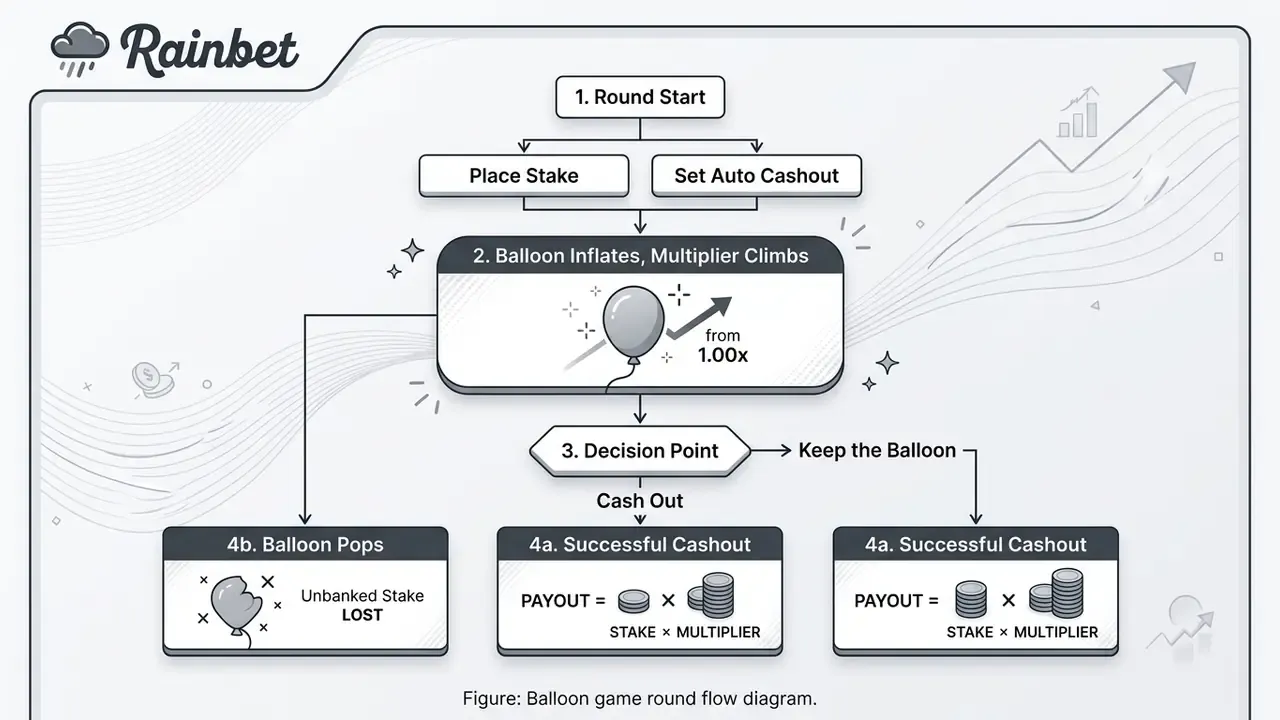
Balloon game round sequence: from stake entry to a banked win or a burst balloon

The round therefore reduces to a four-step loop that will look familiar to anyone who has read behavioural research on the Balloon Analogue Risk Task. The round starts. The balloon inflates while the potential payout grows. You elect to collect at any moment. The outcome resolves as either a banked win or a burst that wipes the accrued amount for that round. The decision point never really goes away: after every fraction of inflation you are implicitly choosing "bank" or "continue".

What Happens When the Balloon Pops

When the balloon pops, the active round ends immediately and all unbanked stakes from that turn are lost. The precise point at which the balloon pops is fixed before the round begins, by a certified Random Number Generator or by a provably fair cryptographic routine that combines server and client seed hashes. Neither the operator nor the player can nudge that timing mid-flight, which is exactly why independent RNG certification is one of the trust signals worth checking in a casino's footer documents.

"The empirically estimated multiplier-distribution exponent was α ≈ 1.98, matching the theoretical value and confirming correct RNG behaviour." (Gambling Fairness Paradox Analysis, 2026; dataset held by the publisher, no public URL released.)

Because the crash threshold is pre-set, human reaction speed only matters in cashing out before that point arrives. Once the pop triggers, network latency or a late click simply means a lost round. Statistical tracking across 7,248 recorded crash-style rounds indicates that roughly 51% to 52% of all rounds crash before reaching 2.00x.

"Of 7,248 recorded rounds across three online casinos, between 51% and 52% ended before reaching a 2x multiplier." (Btcgosu Industry Crash Game Report, 2026; the publisher has not released a public URL for the raw dataset.)

That distribution confirms early pops as a structural feature of the model, not a fault in it. Put plainly: a run of four or five instant pops is not a malfunction, not an operator "cold streak", and not evidence of rigging. It is the expected shape of a high-variance distribution. Uncomfortable, but ordinary.

Round Rhythm and In-Round Decision-Making

The rhythm of Balloon is a rapid repeating cycle where a single round lasts only seconds. Across major platforms, crash-style games run between 150 and 183 complete cycles per hour (Btcgosu Industry Crash Game Report, 2026; published without a supporting public URL, so treat it as indicative rather than audited). The result is a high-tempo decision environment, with a constant choice between locking in a modest return and letting the balloon climb further.

Inside the round, the core question is how long to keep the balloon inflating. As air fills the balloon on screen, time pressure rises in step with the multiplier. Research into smartphone gambling engagement suggests that short, high-frequency round cycles can produce perseverative play if nothing constrains them.

Round Rhythm and In-Round Decision-Making. The

"Participants placed 45,750 bets across 642 days, showing sustained perseverative behaviour even during non-winning phases." (Journal of Behavioral Addictions, 2024; smartphone gambling experiment with 29 participants; no public URL supplied in the source brief.)

Managing that rhythm means setting exit points before the balloon starts rising, rather than improvising while the round is in motion. Some quick arithmetic makes the point better than any warning: at 165 rounds per hour, a flat NZ$2 stake represents about NZ$330 of turnover in sixty minutes. Worth calculating before you open the game, not after.

Balloon Demo: Why Play Free Before Real Money

Balloon demo mode is a training format that lets you experience the mechanics, interface and timing of the game using simulated credits. There is no financial risk, which makes it the sensible first step for reading the rules, testing auto cashout settings and watching volatility behave before real funds are involved.

What Balloon Demo Mode Gives You

Balloon demo mode gives you a fully functional interface with an effectively unlimited virtual balance that can be reloaded whenever you like. In this practice mode you can test the parts that actually matter: manual cashout button latency, auto cashout precision, and double-bet configurations, all under the same RNG conditions as the paid version.

Using a demo game, Kiwi players can build a practical feel for how fast multipliers escalate and how often early pops arrive. Learning the controls while real NZD is on the line is the expensive way round. The demo format is a risk-free place to set personal boundaries and try the session tracking tools.

There is a second benefit that most guides skip. Running the demo on a specific casino platform doubles as a free audit of that operator's technical quality. Watch how fast the game loads. Check whether the cashout button registers instantly on your phone, whether the mobile layout scales properly, and whether the session survives a brief connection drop. If a platform stumbles in demo, it will not improve once your money is riding on it.

What Balloon Demo Mode Gives You

Balloon Game Free vs Balloon Real Money: The Key Difference

The difference between Balloon game free and Balloon real money is financial stakes plus regulatory oversight. In Balloon game free mode, wagers use non-monetary virtual tokens, wins cannot be withdrawn, and losses cost nothing. Balloon real money mode involves an actual NZD balance, so every round carries immediate financial consequences and falls under casino licensing, identity verification (KYC) and harm-minimisation standards.

[QUOTE BLOCK PLACEHOLDER: expert commentary from Cameron "Cam" Ellery, PlayWise NZ, on the psychological shift between demo play and real-money play.]
Purpose: strengthens E-E-A-T by anchoring the point to a named editorial voice.
Semantics: blockquote + cite.
Balloon Game Free vs Balloon Real

"Moving from demo play to real money changes player psychology completely. A practice balance builds familiarity with the controls, but real stakes need structured session limits and a clear understanding of the house edge." (Cameron "Cam" Ellery, Senior Casino Reviewer, PlayWise NZ)

Decision-making shifts between practice and paid modes in ways that are easy to underestimate. Experimental work on simulated gambling shows that trial modes can bend risk perception, so it is worth stating the obvious: demo success does not change the negative expected value of real-money play by a single decimal.

"Participants who played a demo with inflated RTP subsequently wagered significantly higher amounts in real play than the control group." (Lalande et al., 2024; 70 students, slot simulation at 92% versus 180% RTP; no public URL supplied in the source brief.)

The practical implication is slightly awkward. An unusually generous demo session quietly recalibrates your sense of what a "normal" win looks like. If a free run produced three 8.00x cashouts inside twenty rounds, your baseline expectation is now wrong, and that miscalibration walks with you into the real-money lobby.

Responsible gambling disclaimer: Balloon demo exists for mechanics familiarisation and entertainment. Playing in demo mode does not guarantee success or financial gain in real-money play. Real-money gambling involves genuine financial risk, and all players must be 18 or older, or meet the legal gambling age in their jurisdiction. Set strict deposit limits, watch your session time, and never gamble with money reserved for essential living costs. For independent advice and support in New Zealand, contact Gambling Helpline NZ on 0800 654 655.

Additional disclaimer: This information is general in nature and does not replace consultation with a qualified addiction or financial specialist. Demo results do not guarantee comparable outcomes in real-money play.

For detailed reviews of compliant platforms and the full method behind them, see our guide to online casino licensing standards.

How to Launch Balloon Game Online on Desktop and Mobile

Balloon game online runs directly in modern desktop and mobile browsers, with no software installation and no app store detour. Built on responsive HTML5 and JavaScript, the game scales across screen sizes and keeps identical round mechanics on PCs, tablets and phones.

Balloon Play in the Browser

To start browser-based Balloon play, open a licensed online casino that hosts SmartSoft Gaming titles, find the game in the lobby, then choose the demo or real-money launch option. Modern web standards keep the session on an encrypted connection (TLS 1.3) while rendering the inflation animation smoothly.

Browser access also lets you flip between demo and real-money modes without touching system files or granting device permissions. Desktop layouts add usable screen space, which makes it easier to watch the live bet feed, the historical multiplier strip and your session statistics side by side.

A minimal launch sequence looks like this:

  1. Open a licensed casino carrying SmartSoft titles and search the lobby for "Balloon".
  2. Select Demo or Try free rather than the real-money entry point.
  3. Wait for the virtual credit balance to load, typically NZ$1,000 in simulated funds.
  4. Open the settings panel before your first round to confirm the control mode and paytable.
  5. Run your opening rounds at a fixed stake while you watch multiplier behaviour.
Balloon Play in the Browser. To

Balloon Mobile and "Balloon Download"

Balloon mobile play needs no dedicated balloon download and no native application. Mobile browsers on iOS and Android render the HTML5 interface natively, with touch-optimised controls where a tap on the cashout button fires immediate server communication.

Security warning on "balloon download" searches: never install .apk, .exe or .dmg files advertised as "Balloon game apps" from forums, file-sharing sites or ad banners. Legitimate crash games run in-browser, or through an operator's own signed app distributed via the App Store or Google Play. Sideloaded packages promising "prediction", "hack" or "signal" functionality are, without exception, malware, credential-harvesting tools or paid scams. No external application can read or influence a server-side RNG.

Control modes and input mechanics in Balloon game

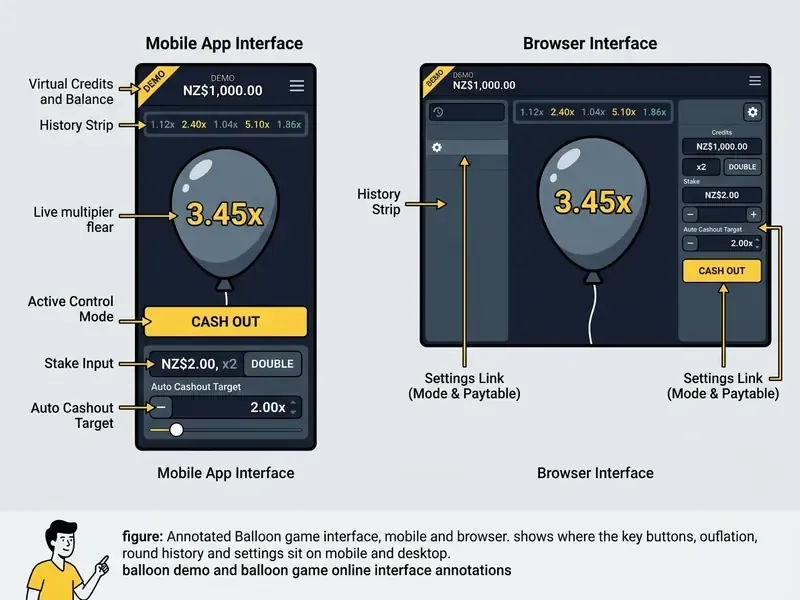
Depending on the provider and platform (the original SmartSoft release, or operator adaptations such as the DraftKings Balloon build), you usually get three control configurations, switchable in settings:

  1. Press and hold (classic hold): you hold the mouse button or on-screen key. Inflation continues until release, which cashes out, or until the balloon bursts. This is the default in most builds.
  2. Tap / air burst (incremental pumping): each tap adds a burst of air and steps the multiplier up. Cashout runs through a separate Take Win or Exitbet button, which helps on touchscreens where sustained pressure is uncomfortable, or where a slipped finger would trigger an unintended exit.
  3. Press and hold with timer: automated hold behaviour with round duration shown in milliseconds, giving you a time reference alongside the multiplier.

Picking the right mode is a real practical decision, not a cosmetic one. Hold-based input punishes accidental release. Tap-based input punishes hesitation. Test both in demo across at least 20 rounds each, then commit to the one you can execute reliably under time pressure. The settings panel is also where you will find the paytable, rules screen, tutorial, sound controls and, in most builds, the balloon skin selector, which has no effect on outcomes whatsoever.

Control modes and input mechanics in
Balloon game online controls: crash history strip, demo mode switch, inflation area, Cash Out button, control mode selector and auto cashout settings

Some casinos offer optional native wrapper apps, but the mobile browser route performs just as well without eating local storage. Browser play also cuts your exposure to persistent push notifications, which supports a calmer, less nudged session.

Balloon Demo Features for Practising Gameplay

The training value of Balloon demo mode rests on its analytical tools, which mirror the automated settings found in real-money crash titles. With auto cashout, session logs and multi-bet setups, you can study how different constraints behave across hundreds of simulated rounds instead of guessing.

Auto Cashout and In-Round Control

Auto cashout lets you define a target multiplier before the round starts, say 1.50x, 2.00x or 5.00x. Once the rising balloon reaches or passes that target, the system banks the win automatically, with no manual click required.

Testing this in demo shows its real usefulness as a discipline mechanism, since it removes emotional hesitation during fast rounds. Behavioural research adds a caveat, though: the presence of a cashout mechanism can push players to raise their stakes, because the safety net feels like protection.

"With a cashout option available, participants wagered on average 34.8% more than without it (95% CI: 20.5 to 52.3%; Cohen's d = 0.75)." (Bennett et al., Psychological Science, 2024; 240 participants across two experiments; no public URL supplied in the source brief.)

Practising with auto cashout in demo helps you spot that tendency in yourself before real money is involved. A useful self-check: note the stake you naturally pick with auto cashout switched off, then note it again with auto cashout armed at 1.50x. If the second figure is noticeably higher, the safety-net effect is working on you exactly as the study predicts. Not a character flaw. Just something to control with a preset limit.

Session Tracking and Two-Bet Simulation

Session tracking tools inside the demo interface log the metrics worth having: total rounds played, net balance movement, average cashout multiplier and peak drawdown sequences. Read across 100 or more practice turns, those numbers give a realistic picture of volatility. Functionally, session tracking preserves the state of one continuous run, so later rounds belong to the same sequence instead of counting as isolated starts. That is what makes drawdown measurement possible at all.

Two-bet simulation lets you place two independent wagers on a single round, each with its own cashout rule. Set Bet A to auto cashout at a low multiplier, say 1.30x, to recover the combined round stake, and leave Bet B for a manual exit or a higher target. One game event, two outcome paths. It is the cleanest way to compare a conservative rule against an aggressive one without the noise of different rounds muddying the comparison.

Session Tracking and Two-Bet Simulation. Session

PlayWise NZ editorial testing note (illustrative walkthrough): Under the published PlayWise NZ framework, a two-bet configuration is assessed like this. Across a 200-round demo block, Bet A is armed at 1.40x and Bet B targets 3.00x, with stake held constant. The expected pattern is straightforward: Bet A lands often enough to cushion the bankroll curve, while early pops below 1.40x still accumulate into a measurable drawdown. The conclusion holds for any split of this kind. Multi-bet configurations redistribute risk across the round; they do not override the house edge built into the game.

Crash History and Colour Logic

A history strip along the lower or side edge of the Balloon interface shows the last 10 to 20 completed rounds with colour markers. Typical banding across crash titles works like this:
  • Red (1.00x to 1.49x):an early burst close to the start of the round.
  • Blue or yellow (1.50x to 2.49x):the mid-range zone where most survivable rounds land.
  • Green or purple (2.50x and above):high multipliers, including the rare outliers.
Crash History and Colour Logic. A

Competitor guides often present this panel as a tactical instrument: red for early, green for high, use the pattern to adjust your next exit. That framing has cost players a great deal of money.

Important fact check: using round history to "predict" the next colour is a textbook Gambler's Fallacy. A certified Random Number Generator has no memory. If five consecutive red results sit in the strip, the probability that the next balloon bursts below 1.50x is still whatever the maths dictates, approximately 51.8%, because independent events do not compensate for past outcomes (see the NIST/SEMATECH e-Handbook of Statistical Methods on independence of events). The history panel is a record, not a signal. Its only legitimate uses are checking that a game behaves within its published distribution, and reviewing your own discipline after the session ends.

Step-by-Step Balloon Demo Testing Protocol

To make demo mode genuinely useful, rather than a warm-up for impulsive play, run a structured test instead of clicking freely:

  1. Fix a starting balance: allocate exactly 1,000 virtual credits and refuse to top up mid-test. A reloadable balance destroys the experiment, because you can no longer see the point at which you would have gone broke.
  2. Lock a constant auto cashout: set 1.50x for the first 50 rounds and leave it alone, whatever the history strip is doing.
  3. Log every round in a spreadsheet: the multiplier reached, whether you banked, and the running balance.
  4. Change one variable only: for rounds 51 to 100, raise the target to 2.00x and keep the stake identical.
  5. Compare drawdowns, not totals: headline profit across 100 rounds is meaningless noise. The maximum peak-to-trough fall is the number that predicts how a real bankroll will feel.
Step-by-Step Balloon Demo Testing Protocol. To
Session blockStake (NZD equivalent)Auto cashout targetOutcome (win/loss)Max drawdown
Rounds 1 to 5010.001.50xTo be completedRecord the deepest balance fall
Rounds 51 to 10010.002.00xTo be completedCompare losing-streak length
Rounds 101 to 150 (optional)10.003.00xTo be completedNote the longest run without a bank

This experiment reliably demonstrates something no strategy article can talk its way out of. At a 2.00x target, runs of four to six consecutive early bursts are inevitable even over short distances, and at a 3.00x target those runs stretch further. Treat the demo seriously, because habits formed in a free session transfer straight into paid play, the bad ones included. Observe, log, act with intent. Random clicking teaches nothing.

Balloon Strategy: Approaches to Test in Demo Mode

Disclaimer: This information is general in nature and does not replace advice from a qualified professional. No strategy removes the negative mathematical expectation of crash games.

Testing a Balloon strategy in demo mode is really an exercise in comparing threshold policies across a statistical sample. Strategic adjustments change bankroll variance and win frequency. What they cannot change, and the maths here is not open to debate, is the negative expected value created by the house edge.

Early Exits and Middle Multipliers

An early exit strategy sets auto cashout at conservative thresholds between 1.10x and 1.35x. This produces a high frequency of winning rounds and a smoother bankroll curve. The catch: when an early pop lands at, say, 1.02x, recovering that stake takes several consecutive successful rounds.

A middle multiplier strategy targets thresholds between 1.50x and 2.50x, trading some win probability for a bigger payout. Mathematically, the expected return E[R] for any fixed cashout threshold c is:

E[R] = c × P(M ≥ c) = c × (RTP / c) = RTP

Here M is the random crash multiplier and RTP is the Return to Player percentage.

Early Exits and Middle Multipliers. An

"For any fixed cashout threshold c, the expected return equals RTP and is independent of the choice of c: E[R] = c · (RTP/c) = RTP." (Gambling Fairness Paradox Analysis, 2026; the publisher has not released a public URL.)

The formula settles the argument. Whether you exit early at 1.20x or hold to 2.00x, long-term expectation stays equal to the game's base RTP, often quoted near 99% in low-margin crash builds, leaving roughly a 1% house edge. What actually changes between thresholds is shape. Low targets give frequent small wins punctuated by sharp gaps. Higher targets give rare large wins separated by long dry spells. Choosing a threshold is a choice about the emotional texture of your session, not about profitability.

Long Holds: Why a Strategy Is Never a Guarantee

Long hold strategies push toward 5.00x, 10.00x or beyond. Those targets pay handsomely on the rounds that survive, and they come bundled with extreme variance and lengthy losing streaks.

"Across 7,248 observed rounds, roughly 90% ended before reaching a 10x multiplier, while isolated rounds occasionally exceeded 5,000x." (Btcgosu Industry Crash Game Report, 2026; the publisher has not released a public URL for the underlying dataset, so treat the figure as indicative industry observation rather than audited data.)

Worth separating two things that share a theme. Casual children's balloon popping games and party entertainment apps are about motor skills and fun, with nothing wagered; they build hand-eye coordination, turn-taking and emotional regulation. Online casino Balloon game is an 18+ real-money gambling title governed by probability distributions and random number generators. The visual metaphor is shared. The risk profile is not remotely comparable. Testing long holds in demo makes that vivid, since consecutive failed rounds erode a virtual balance quickly, which is precisely why no strategic adjustment should ever be sold as a guaranteed profit method.

The same logic disposes of progressive staking. Doubling after a loss, the Martingale approach, does not improve the odds that the next balloon survives. It simply pours a larger share of your bankroll into a single independent event with unchanged probabilities. Because crash distributions carry long tails of early bursts, a Martingale sequence can hit table limits or empty the bankroll well before the "due" win arrives. The win was never due.

Worth separating two things that share

Fact check and strategy warning: Every round in Balloon game is mathematically independent of previous outcomes. The certified Random Number Generator holds no memory of past pops, multiplier streaks or player loss patterns. Progressive betting systems, Martingale included, cannot alter the statistical distribution or guarantee a win rate. Claiming that a strategy removes risk contradicts basic probability theory (NIST/SEMATECH e-Handbook of Statistical Methods). Any product, channel or "signal group" promising predicted crash points is misrepresenting how RNG-driven games work.

How to Assess a Balloon Casino Offer Before Playing for Money

Before you move from demo practice to real-money play at a Balloon casino, assess the operator with the same rigour you applied to the game. The PlayWise NZ review criteria put regulatory safety first, then clear NZD payment terms, published game parameters and accessible harm-minimisation tools. In that order, deliberately.

Key criteria to check before depositing:

1
Licensing and regulatory compliance: confirm the casino holds a valid licence from a recognised authority, such as the MGA, or operates in line with DIA 2026 framework guidance for services reachable from New Zealand, and enforces 18+ age verification. Our reference material on online casino licensing explains how to locate and validate a licence number instead of trusting a footer badge image.
2
Published game parameters: the operator should display the official game RTP and give direct access to the rules, plus provably fair verification tools where offered, so a round's outcome can be recomputed from the published seeds.
3
Transparent bonus terms: read the fine print on welcome offers, then do the arithmetic yourself. As an illustration only, since figures vary by operator and no industry standard exists, a 40x requirement on an NZ$20 bonus implies roughly NZ$800 of turnover before withdrawal is permitted. Check whether crash games contribute 100% or a reduced percentage toward wagering, because many operators discount them heavily or exclude them outright.
4
NZD payment reliability and verification: confirm that local deposit and withdrawal methods process in NZD without hidden conversion fees. In practice, NZ-facing platforms commonly support Visa and Mastercard debit issued by New Zealand banks, instant bank transfer options including POLi where a bank still supports it, Apple Pay and Google Pay, plus e-wallets such as Skrill, Neteller or ecoPayz. Typical processing windows, always to be checked against the operator's own banking page, run from a few hours to 24 hours for e-wallets, roughly 1 to 3 business days for card withdrawals, and 1 to 5 business days for direct bank transfers. Any operator unwilling to state a withdrawal timeframe in writing should be treated as unverified.
5
KYC readiness: identity verification is a legal requirement, not an obstacle. Preparing documents in advance is the single most effective way to avoid payout delays.
6
Responsible gambling infrastructure: check for instant deposit limits, reality check timers, cool-off periods, session reminders and self-exclusion inside the account dashboard. Then check that a limit reduction applies immediately rather than after a convenient "cooling" delay, which is a quiet but telling difference between operators.

Pre-withdrawal KYC checklist for NZ players:

  • Photo ID: a New Zealand passport or full driver licence, unexpired, all four corners visible.
  • Proof of address: utility bill, council rates notice or bank statement dated within the last three months, showing your name and residential address.
  • Proof of payment method: a redacted card image (first six and last four digits visible only) or an e-wallet screenshot matching the name on the casino account.
  • Source of funds: occasionally requested for larger cumulative withdrawals. A recent payslip or bank statement is standard.
  • Name consistency: casino account, ID and payment method must match exactly. A missing middle name is one of the most common causes of a stalled payout.

To compare how the three access formats structure terms, exposure and practice value, read the summary below:

FormatPrimary PurposeAccess & Account TermsTraining CapabilityFinancial Risk Level
Balloon demoRisk-free mechanics familiarisation and UI testing.Instant browser access; usually no registration; virtual balance.High: replicates the exact controls, auto cashout timing and RNG mechanics.None: wagers use simulated credits; wins and losses carry no monetary value.
Balloon game free (social / sweeps)Casual entertainment via virtual tokens or sweepstakes.Account creation required; virtual coins earned or bought in packages.Moderate: mechanics mirror real play, though sweepstakes odds may differ.Indirect: free to enter, but in-app coin purchases introduce real spending.
Balloon real moneyReal stakes with cash payout potential.Mandatory registration, 18+ age and KYC verification; NZD deposits.Low to moderate: focus shifts to live execution and bankroll management.Direct: genuine financial risk shaped by the house edge and fast round tempo.

Note on the table: Balloon demo mode simulates round mechanics and control features accurately, so the training value is real. Moving to real-money play introduces exposure the demo cannot teach you to feel. Evaluate operator terms independently and set deposit limits before your first NZD stake. For platform reviews and the method behind them, see our guides on online casino licensing standards.

Setting a Session Budget That Survives the Tempo

One more calculation, and it is the one most players skip. Decide your session budget in rounds, not in dollars. If your entertainment budget for the evening is NZ$50 and you intend to play for an hour at roughly 165 rounds, a NZ$2 flat stake exposes NZ$330 of turnover against a NZ$50 buffer. High variance plus that ratio means the session can end early through ordinary bad luck, not misfortune.

A safer frame: pick a stake where 100 losing rounds in a row would still sit inside your budget. At NZ$0.50, that is NZ$50. Uncomfortable maths, useful maths. Then set the number inside the account as a deposit limit, because a limit written in your head has no enforcement mechanism at 11pm.

Setting a Session Budget That Survives

Next Steps for NZ Players: Pre-Bet Checklist

Work through this list before your first real NZD round. If any item is unticked, stay in demo.

  • I have run at least 100 logged demo rounds and recorded my maximum drawdown.
  • I have confirmed which control mode (hold, tap, or hold with timer) I can execute reliably.
  • I have read the in-game paytable and found the published RTP figure.
  • I have verified the operator's licence number on the regulator's own register.
  • I have confirmed the withdrawal method, NZD fees and stated processing timeframe.
  • My KYC documents are ready and the account name matches my ID exactly.
  • I have set a deposit limit and a session time reminder inside the account dashboard.
  • I have chosen a stake I would be entirely comfortable losing across 165 rounds in an hour.
  • I accept that the history strip predicts nothing and that no strategy removes the house edge.
  • I know Gambling Helpline NZ is free on 0800 654 655 if play stops feeling like entertainment.
Next Steps for NZ Players Pre-Bet

FAQ About Balloon Game

Final Word

Balloon rewards discipline in one narrow sense. A player who sets a stake, sets a threshold, logs the results and stops on schedule will lose money more slowly and enjoy the session more than someone chasing colour patterns in the history strip. Nothing here can be solved, predicted or beaten, because the RNG settles every round before the first puff of air. Use the demo as a measuring tool. Verify the operator before you deposit. Keep your limits set inside the account rather than in your head. And treat any content promising guaranteed Balloon wins as information about its author rather than about the game.

This article is general information about game mechanics and operator assessment. It is not financial, legal or medical advice, and it does not replace consultation with a qualified specialist. Gambling involves real financial risk. 18+ only. Free, confidential support is available in New Zealand from Gambling Helpline NZ on 0800 654 655.

Final Word. Balloon rewards discipline in