"When reviewing any online casino cashier, the golden rule is simple: look past the marketing headlines and verify the actual transactional terms before sending a single cent. Understanding minimum deposits, network fees, and processing times is what keeps your bankroll intact and your play safe." — Cameron "Cam" Ellery, PlayWise NZ Editorial Voice

Rainbet Minimum Deposit: Limits in NZD, Payment Methods, Fees and Processing Times

Last updated: 2026 review cycle | Author: Cameron "Cam" Ellery, PlayWise NZ Editorial Voice
Rainbet Minimum Deposit at a Glance

  • Lowest entry point:roughly NZ$10 (about $5 USD equivalent) using Litecoin, Solana or Toncoin; NZ$20 to NZ$30 for BTC, ETH and stablecoins.
  • Fiat rails (cards, bank transfer, e-wallets):typically NZ$25 to NZ$40 minimum, with standard maximums clearing up to NZ$10,000 per transfer.
  • Bonus threshold is not the cashier threshold:the welcome package requires a minimum of NZ$20 per deposit stage across your first three deposits (100% + 50% + 100% match, each with 20 free spins).
  • Fees:Rainbet charges no operator deposit fee; you pay the blockchain network or gas fee, and a small card-network charge applies in a few regions.
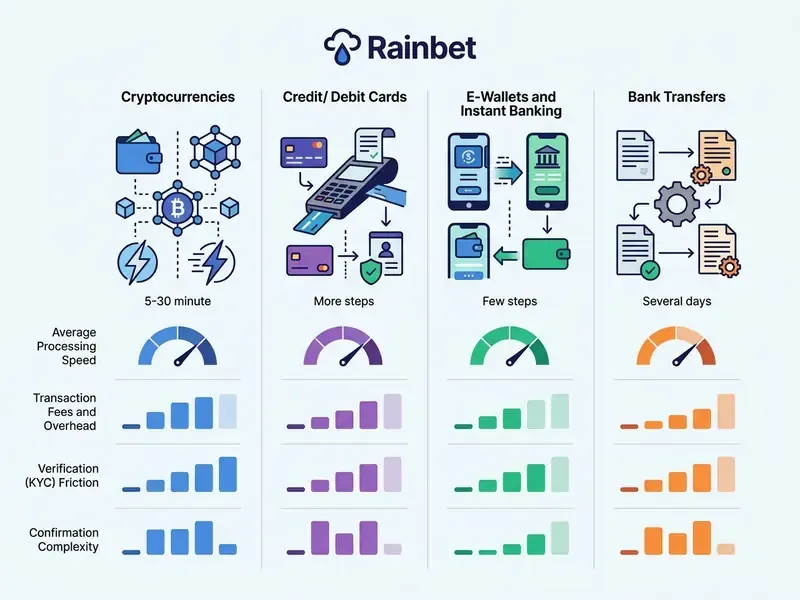
  • Speed:instant for cards, e-wallets and local instant banking; 5 to 30 minutes for crypto, depending on block confirmations.
Rainbet Minimum Deposit at a Glance

Before you claim a welcome offer or transfer funds to any online gaming platform, checking the exact cashier terms is the single most important step for protecting your bankroll. Rainbet operates as a crypto-centric online casino and sportsbook aimed at multiple international jurisdictions. So the Rainbet minimum deposit is not one fixed global figure. It shifts with your location, your chosen payment method, the underlying currency, and current blockchain network traffic.

For New Zealand players comparing international platforms, those moving limits need a calm, fact-based approach. Crypto deposits can start from the equivalent of $5 to $15 USD, roughly NZ$10 to NZ$25 depending on the token, while fiat routes such as credit cards or bank transfers usually sit higher. At PlayWise NZ, our transparent review method puts player safety first, breaks terms down in plain English, and keeps harm minimisation front and centre.

Before you claim a welcome offer

Why the Minimum Deposit Deserves Two Minutes of Your Attention

Here is the practical reason this small number matters. A NZ$10 floor sounds friendly, but if the network fee on your chosen chain is NZ$4, you have just lost 40% of your funding before a single spin. Choose a cheaper chain and that same NZ$10 arrives almost whole.

The second reason is budgeting. A low minimum lets you test an operator with an amount you are genuinely comfortable losing, which is exactly how a cautious first deposit should feel. Boring. Controlled.

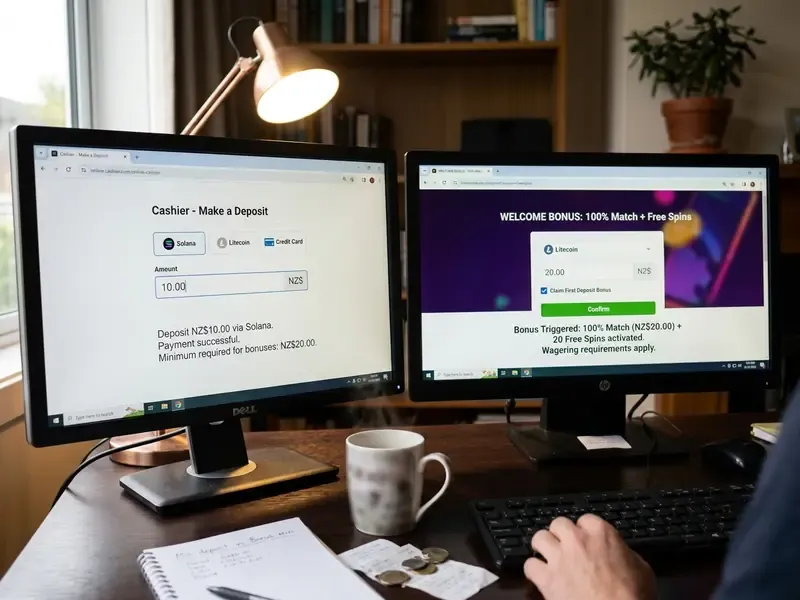
Third, bonus qualification. Fund NZ$10 when the promotion needs NZ$20 and the deposit still credits, yet the free spins never arrive. That mismatch is the most common complaint players raise about three-stage welcome packages, and it is entirely avoidable if you read the cashier screen first.

Set your own deposit limit before any of this, not after a losing session.

Why the Minimum Deposit Deserves Two

What the Rainbet Minimum Deposit Means and What Determines the Amount

The term Rainbet minimum deposit refers to the lowest amount you can transfer into your account balance in a single transaction and still have it credited. That baseline is dynamic. It depends on the selected payment method, the payment provider handling the transaction, your account currency, and any network overheads. If you are still shortlisting operators, it pays to compare payment methods for online casinos side by side before you commit funds to any single cashier.

A general minimum Rainbet deposit for major cryptocurrencies such as Bitcoin (BTC) or Ethereum (ETH) often lands between £10 and £15, roughly NZ$20 to NZ$30. Alternative coins like Litecoin (LTC), Solana (SOL) or Toncoin (TON) can accept transfers from around £5 equivalent, roughly NZ$10. Traditional fiat Rainbet payment methods such as Visa, Mastercard or direct bank transfers usually enforce higher deposit limits, commonly NZ$25 to NZ$40, to cover fixed merchant acquiring costs and interchange fees.

One distinction is worth pinning down. A commercial transactional floor is not the same thing as a responsible gambling deposit limit, which is a voluntary safety ceiling you set yourself to cap spending over a day, week or month.

What the Rainbet Minimum Deposit Means

«The regulator requires that the term "deposit limit" applies solely to gross deposits within a period, not to losses and not to net deposits.» — UK Gambling Commission, Supplementary Consultation on Deposit Limits (Remote Gambling and Software Technical Standards), 2024–2025. https://www.gamblingcommission.gov.uk

In practice, a cashier minimum tells you the smallest amount the payment rail will accept. A deposit limit is the largest amount you have personally authorised yourself to fund in a set period. New Zealand's online casino framework treats the second category as a harm-minimisation tool rather than a commercial setting (NZ Department of Internal Affairs, Online Casino Gambling (Minimum Standards) 2026. https://www.dia.govt.nz).

Why the Minimum Deposit Differs Between Payment Methods

The spread across payment methods comes down to transaction economics, chargeback exposure and settlement costs.

For card schemes (Visa and Mastercard) and traditional banking rails, processors charge flat interchange and merchant fees on every transaction, plus percentage rates on top.

«Card schemes and acquiring banks charge a fixed fee plus a percentage on every transaction, which makes micro-deposits economically unviable for the operator.» — UNLV Center for Gaming Research, Alternative Payment Mechanisms in Online Gambling, 2024. https://gaming.unlv.edu

So the casino lifts the minimum deposit on fiat rails, typically to NZ$25 to NZ$40, to stop small transfers eroding its margins. Crypto deposits skip traditional merchant acquirers entirely. Because the player covers the blockchain network fee, Rainbet can hold a much lower floor of around NZ$10 for Litecoin, Solana or Toncoin without absorbing direct processing losses.

There is a quieter factor too: chargeback risk. Card payments can be reversed weeks later, crypto cannot, and that asymmetry shapes limits as much as fee tables do.

Where to Check the Live Minimum Deposit Before Paying

To confirm the active minimum before transferring anything, log into your account and open the Cashier or Wallet tab.

Inside the Cashier, selecting a specific deposit method, whether a crypto token like Bitcoin or an e-wallet, triggers a live summary with the current minimum, maximum transaction caps, and any gateway messaging. Read those parameters on screen before confirming, because operator terms and provider thresholds are updated regularly in response to market and regulatory conditions.

A five-second routine works well: open the Cashier, select the coin or card, read the on-screen minimum, check the displayed currency matches your account currency (NZD, USD, CAD or EUR), then enter the amount. Only then.

Where to Check the Live Minimum

Deposit Bonus and Welcome Bonus: What to Check Before Funding

Before depositing to claim a welcome bonus or deposit bonus, read the offer's specific terms, qualifying thresholds and wagering requirements.

A common trap is assuming the cashier minimum automatically qualifies you for a promotion. It does not. Operator promotional terms and regulatory guidance both treat bonus qualification as a separate contractual condition from the cashier floor. Operators frequently set a higher threshold for bonus activation, such as NZ$20 to NZ$50 for a 100% match, even where the general minimum for Litecoin, Toncoin or UPI is far lower (PlayWise NZ Editorial Method; verification of live promotional terms in the Cashier is required, since operator bonus documentation changes without notice). Check as well whether specific payment methods, such as certain e-wallets or stablecoins, are excluded from bonus eligibility, and enter any required bonus code in the Cashier before you confirm payment.

Deposit Bonus and Welcome Bonus What

«New Zealand's 2026 online casino minimum standards require operators to prompt players to set a financial limit as early as possible.» — New Zealand Department of Internal Affairs, Online Casino Gambling (Minimum Standards) 2026. https://www.dia.govt.nz

Example Wagering Calculation ("Quick Maths"):
A 100% deposit bonus on an NZ$50 deposit gives you NZ$50 in bonus funds.
If the offer carries a 40x wagering requirement on the bonus balance:
40 × NZ$50 = NZ$2,000 total wagering required before bonus funds convert to withdrawable cash.
Always calculate these figures first to ensure the offer fits your playing budget.

Two thousand dollars of turnover on a fifty dollar deposit. Worth sitting with that number for a moment before you accept the offer. Before you commit, it also helps to compare welcome bonus terms at online casinos so you can benchmark wagering multiples, expiry windows and excluded payment rails against the wider market.

Example Wagering Calculation Quick Maths A

Rainbet 3-Tier Welcome Bonus Match Breakdown

To trigger the deposit bonus tiers correctly, your funding amounts must meet the minimum for each of your first three deposits:

  1. 1st Deposit: 100% match bonus plus 20 free spins (minimum qualifying deposit NZ$20, about $15 USD equivalent).
  2. 2nd Deposit: 50% match bonus plus 20 free spins (minimum qualifying deposit NZ$20, about $15 USD equivalent).
  3. 3rd Deposit: 100% match bonus plus 20 free spins (minimum qualifying deposit NZ$20, about $15 USD equivalent).

Note: standard crypto minimums can start as low as about NZ$10 equivalent for Litecoin, Solana or Toncoin, but bonus activation strictly requires NZ$20 at each stage. Under-funding stage two or three is the single most common reason players report "missing" free spins.

Rainbet 3-Tier Welcome Bonus Match Breakdown

Rainbet Deposit Methods: Available Funding Options

Rainbet runs a hybrid deposit infrastructure that leads with crypto deposits while keeping support for regional fiat gateways, e-wallets and traditional banking.

«Look past the marketing headlines and check the real transactional terms, that is exactly what keeps your bankroll intact.» — Cameron "Cam" Ellery, PlayWise NZ Editorial Voice (source: PlayWise NZ editorial brief)
The payment matrix rests on three pillars: digital assets (cryptocurrencies like Bitcoin, Ethereum, Toncoin and Solana), fiat rails (Visa, Mastercard, bank transfers), and localised instant payment methods such as Interac in Canada, PIX in Brazil or UPI in India. Account currencies commonly supported include New Zealand dollars (NZD), US dollars, Canadian dollars and euros, which spares NZ players an FX conversion on every single transaction.

Choosing the best deposit option comes down to your own priorities: processing speed, privacy, transaction overhead and local currency convenience. For New Zealand players after trustworthy casino insights, weighing these Rainbet deposit options against local standards is part of keeping control of a gaming budget (PlayWise NZ Editorial Standards), and our overview of online casino standards for players sets out the criteria we apply.

The payment matrix rests on three

Crypto Deposits: Bitcoin, Ethereum, Toncoin and Other Cryptocurrencies

Rainbet crypto deposits form the core of the platform's payment ecosystem, with support for more than 20 individual cryptocurrencies across multiple blockchain networks.

Supported digital assets include major market-cap coins such as Bitcoin (BTC), Ethereum (ETH), Litecoin (LTC), Solana (SOL), Toncoin (TON), TRON (TRX), Ripple (XRP), Dogecoin (DOGE) and Cardano (ADA), plus stablecoins like USDT and USDC across ERC-20, TRC-20 and Solana standards. When funding with crypto, you select both the specific coin and the matching network inside the Cashier. The platform then generates a unique wallet address and QR code. Crediting time depends on confirmation requirements, from a single confirmation for Litecoin up to around 12 for some ERC-20 tokens.

Crypto Deposits Bitcoin, Ethereum, Toncoin and

«Wallet-to-wallet crypto deposits at online casinos involve a transfer from the player's personal wallet to the operator's wallet; withdrawals return to the same address.» — UNLV International Gaming Institute, Cryptocurrency in the Gaming Sector, 2024. https://gaming.unlv.edu

That architecture has one practical consequence for New Zealand players. The wallet you deposit from effectively becomes your withdrawal destination, so use a wallet you fully control rather than a temporary exchange address you might lose access to later.

Bank Transfers and E-Wallets for Funding Your Account

Fiat funding at Rainbet covers debit and credit cards, e-wallets and direct bank transfers, depending on your registered region.

Options like Skrill and Neteller deposit quickly and add a layer of privacy, keeping casino transactions separate from your main bank account.

«Skrill and Neteller (Paysafe) are extremely popular in online gambling because of speed, convenience, and the separation of transactions from the main bank account.» — UNLV Center for Gaming Research, Alternative Payment Mechanisms in Online Gambling, 2024. https://gaming.unlv.edu

Local instant banking rails such as Interac or Faster Payments push money straight from a personal bank account, usually clearing instantly or within a few hours. Traditional bank transfer remains available for larger sums, though it carries a higher minimum of around NZ$40 and can take up to three business days to settle fully.

One note for Kiwi players: domestic account-to-account rails are not universally offered by offshore operators. If a direct NZ bank option is not visible in your Cashier, an e-wallet or a low-fee crypto route is normally the faster substitute.

Rainbet Fees and Deposit Limits

Rainbet applies a general policy of zero operator-side deposit fees on incoming payments. You remain responsible for external network charges and any gateway fees.

Disclaimer: Information about fees and limits is general in nature and may change without notice. Always check the current terms in your own Rainbet Cashier before executing a transaction.

Rainbet does not deduct a commission from your deposit, but external intermediaries can. Blockchain networks and card processing facilities both add costs of their own. Every on-chain transfer carries a mandatory network or "gas" fee paid directly to miners and validators. Some regional fiat methods, for instance card deposits in certain jurisdictions, may attract an acquiring network fee, with roughly 2.5% recorded for card processing in select international markets. Knowing these Rainbet transaction fees in advance tells you the exact net amount that will land in your playable balance.

Which Fees Apply to Crypto Transactions

On-chain crypto deposits attract network fees, also called gas fees, set entirely by blockchain congestion and smart contract execution rules.

When you send Bitcoin, Ethereum or ERC-20 tokens, the sending wallet pays that fee to the network for validation.

«When Bitcoin is transferred the network charges a fee to miners; for USDT on TRC-20 or Solana that fee amounts to fractions of a dollar.» — UNLV International Gaming Institute, Cryptocurrency in the Gaming Sector, 2024. https://gaming.unlv.edu

A Bitcoin transfer might carry a network fee in the region of 0.00005 BTC. Treat that as indicative only, because mempool congestion can move it several-fold inside a single day, so check the live estimate in your wallet before signing. USDT on TRC-20 or Solana typically costs a fraction of a dollar, and Toncoin transfers sit at roughly 0.005 TON. These costs are paid by the sender and are separate from Rainbet's cashier terms.

Send a deposit that is too small and the network fee can swallow a painful share of it. A simple rule of thumb for NZ players: if the fee exceeds about 2% of your intended deposit, switch to a cheaper chain such as Solana, TRON or TON.

A Bitcoin transfer might carry a

Minimum and Maximum Deposit Limits

Rainbet applies layered deposit limits, with both minimum transactional floors and maximum single-transfer caps across its cashier options.

Minimums exist to stop transfers that are unviable for the network or gateway to process. Maximums manage financial exposure and satisfy regional AML protocols.

«Maximum transaction limits for methods such as Interac or PIX protect against financial risk and align with regional AML requirements.» — UNLV Center for Gaming Research, Alternative Payment Mechanisms in Online Gambling, 2024. https://gaming.unlv.edu

For New Zealand players, the working range for Rainbet deposit limits runs from roughly NZ$10 at the low end to NZ$10,000 per standard transaction at the high end. Fiat methods such as Interac or PIX often cap individual transactions at the equivalent of NZ$10,000 (CAD 5,000 or $5,000 USD in their home markets), while standard crypto deposits frequently carry no maximum single-transfer ceiling, as cross-referenced in the limits table earlier in this guide. High-volume and VIP players can often arrange raised caps with account management. Standard tiers may still face daily aggregate caps across both deposits and withdrawals.

A ceiling is not a target, though. If a raised cap feels tempting, that is usually the moment to revisit your own deposit limit instead.

For New Zealand players, the working

How to Make a Deposit on Rainbet: Step-by-Step Order of Actions

To fund your account without technical errors or delays, follow a structured process inside the dashboard.

Depositing means selecting an authenticated payment route, checking every transactional parameter, and transmitting the funds accurately. Whether you use a fiat card or a personal crypto wallet, a methodical approach heads off the usual pitfalls: mismatched network chains, missed bonus qualifications, or an amount that sits a dollar under the floor.

Choosing a Payment Method and Confirming the Amount

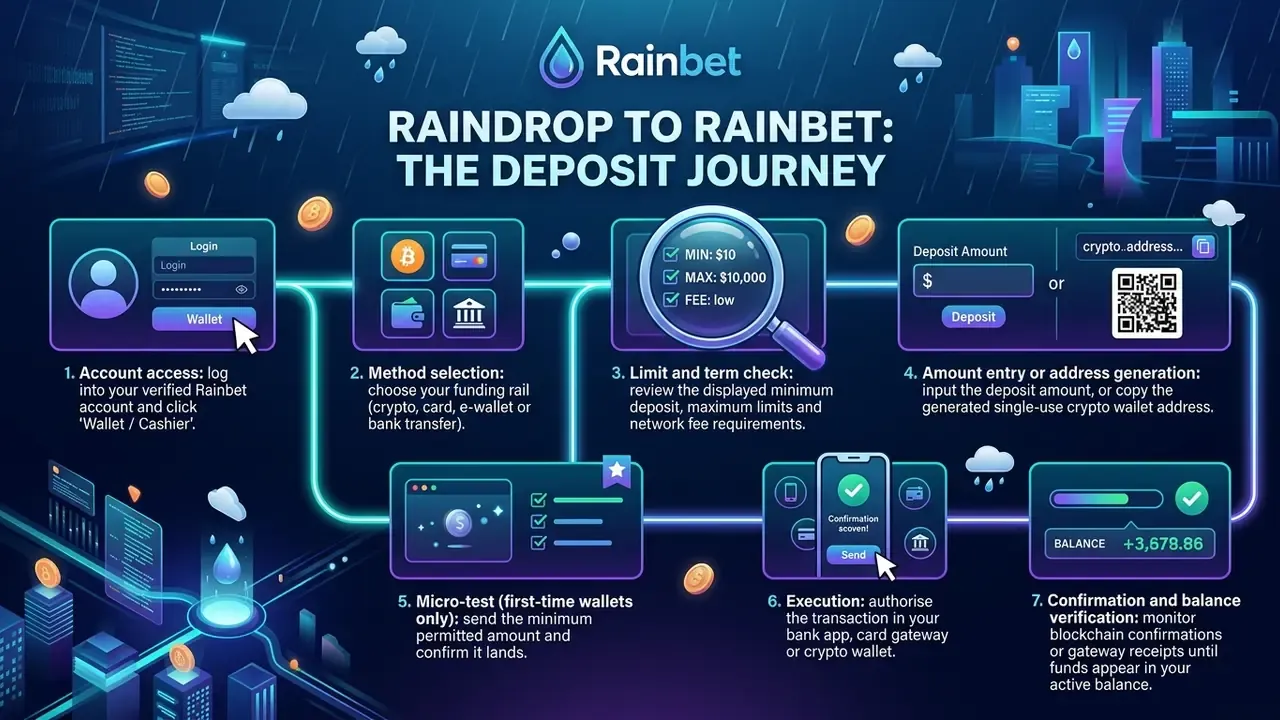
Start by signing into your Rainbet account and opening the Cashier or Wallet section.

Select your preferred payment method from the list. Enter the amount you want to deposit, making sure it meets or exceeds the stated minimum deposit. If you plan to claim a promotion such as a welcome bonus, confirm your amount also meets the qualifying threshold, which can be higher than the cashier minimum, for example NZ$20 per bonus stage or NZ$50 for a larger match. Then confirm.

How to Send a Crypto Deposit Without a Network Error

With any crypto deposit, matching the exact asset, network chain and address shown by the platform is critical.

  1. Select the specific cryptocurrency (for example USDT, TON or SOL) in the Rainbet Cashier.
  2. Choose the correct network chain (for example TRC-20, ERC-20, TON or Solana).
  3. Copy the generated wallet address, or scan the displayed QR code with your mobile crypto wallet.
  4. Open your personal crypto wallet, choose "Send", paste the address, and check that the first and last four characters match perfectly.
  5. Enter an amount above the required minimum deposit plus the network fee, then confirm the transfer.
  6. Run a micro-test transfer: if you are depositing from a new wallet or trying an unfamiliar chain such as Solana, TON or TRON, send the smallest allowed amount first (for example 0.05 LTC or 10 USDT). Confirm it settles in your Rainbet wallet before sending more. A NZ$10 test costs far less than a misrouted NZ$500 transfer.
How to Send a Crypto Deposit

How Long Crediting Takes and What to Do When a Rainbet Deposit Is Pending

So how long does Rainbet deposit take? It depends entirely on the rail you choose, from a few seconds for local instant banking up to about 30 minutes for crypto during busy periods.

Fiat methods such as credit cards, Interac or UPI clear almost instantly. Crypto transactions need a set number of block confirmations before the platform credits your funds. When a transfer shows a Rainbet deposit pending status, it usually means the transaction is waiting on further confirmations, or the third-party payment provider has not cleared it yet.

«A meta-analysis of 70 studies found trust to be the most influential factor in digital payment method choice, partially mediating social norms and perceived ease of use.» — Neves et al., Digital Payment Intention to Use: A Meta-Analytic Structural Equation Modelling Study, 2024. https://doi.org/10.1016/j.elerap.2024.101433

That finding explains why a transparent pending status matters so much. Players judge a cashier less on raw speed than on whether they can see, verify and trust what is happening to their money mid-transfer.

What Determines Processing Times

Processing times for incoming transactions are governed by external network performance and gateway clearing protocols, not by how urgently you would like to start playing.

For crypto deposits, timing tracks current blockchain congestion and gas prices. During heavy network activity, Bitcoin or Ethereum transfers take longer to reach the required confirmations.

«Blockchain congestion and prevailing gas prices determine how quickly a wallet-to-wallet gaming deposit reaches the confirmations required for crediting.» — UNLV International Gaming Institute, Cryptocurrency in the Gaming Sector, 2024. https://gaming.unlv.edu

For fiat payments, delays usually trace back to bank security checks, 3D Secure verification, or batch settlement windows enforced by banking portals. Weekend traffic and issuer risk filters add friction as well, which is why an "instant" label always stays provider-dependent.

Checking Transaction Status and Contacting Support

If a deposit stays pending past the usual window, track it with transactional identifiers before you contact customer service.

For digital assets, copy the Transaction ID (TxID or hash) from your wallet and paste it into a public blockchain explorer such as Etherscan, Tonviewer, Solscan or Blockchain.com to see whether the required confirmations are complete. If the explorer shows the transaction fully confirmed but your casino balance is still empty, or a fiat transfer stalls, contact Rainbet live support. Give them your account username, the exact deposit amount, the timestamp, the coin and network used, the destination wallet address, the payment method, and the TxID or bank reference number so they can reconcile it manually.

Escalation checklist for a stuck deposit:

  1. Confirm the explorer status: pending, confirmed or failed.
  2. Check the Cashier transaction history for a "processing" entry.
  3. Wait out congestion windows before escalating, up to 30 minutes for BTC or ETH.
  4. Open live chat with the full data set above attached.
  5. Never share your password, seed phrase or private keys with anyone claiming to be support. Legitimate staff will never ask.
Checking Transaction Status and Contacting Support

Security of Rainbet Deposits and Verification of Payment Details

Keeping a deposit safe comes down to three habits: double-check payment details, protect your login credentials, and only ever use the official platform interface.

Rainbet operates under an official Curaçao eGaming licence, which requires cashier software, random number generators and payment gateways to meet defined international compliance standards. That oversight also expects segregated operational balances and encrypted SSL channels for all incoming payments. Licensing is no guarantee of outcome, and it will not make a losing session profitable. What it does give you is a documented complaints pathway that unlicensed platforms simply cannot offer.

Because online gaming moves real money, personal security habits matter just as much. From verifying long cryptographic wallet strings to switching on account protection tools, small precautions protect your funds from misdirection, phishing and unauthorised access.

Security of Rainbet Deposits and Verification

Verifying the Crypto Wallet and Network Before Transferring

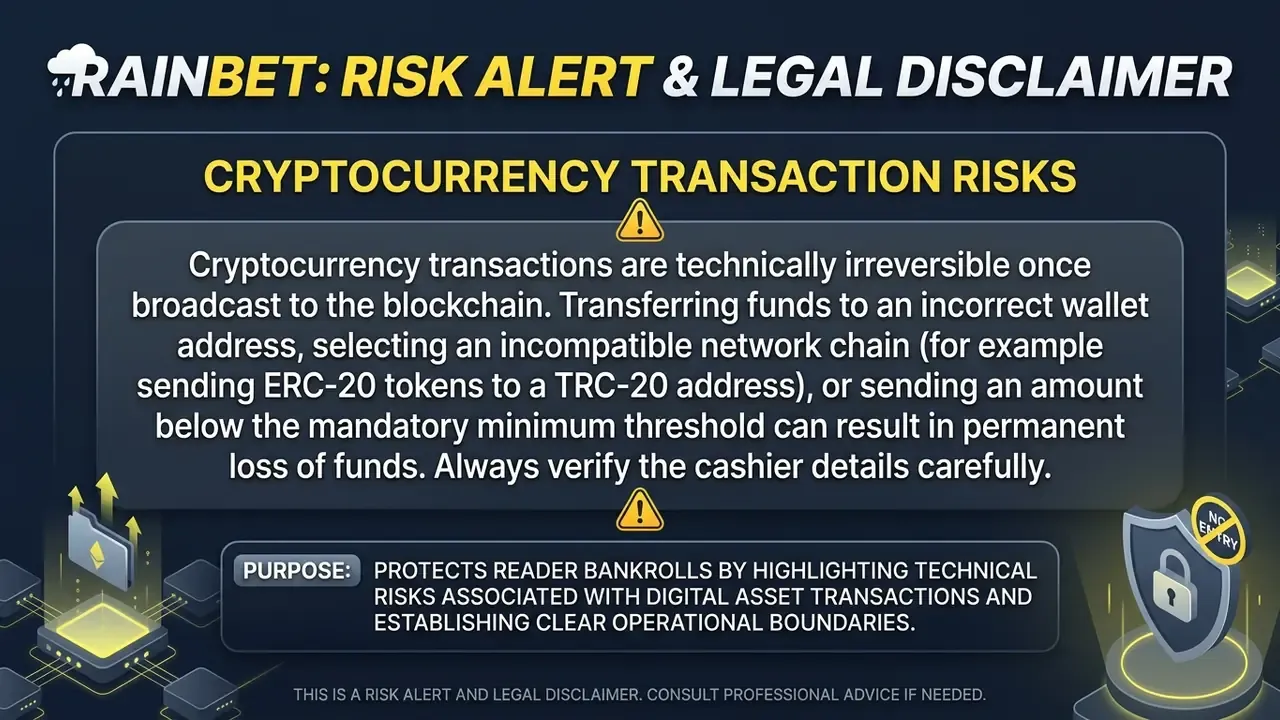
Disclaimer: Cryptocurrency transactions are irreversible once confirmed on the blockchain. Sending funds to an incorrect address or an incompatible network can result in permanent loss. This information is general in nature and does not replace professional advice.

Before broadcasting any digital asset transaction, check systematically that the recipient address, the asset ticker and the network protocol all match.

Sending across mismatched chains, such as ERC-20 tokens to a BEP-20 address, usually means the funds are gone for good.

«Online casinos using wallet-to-wallet crypto transactions must warn players that sending funds to an incorrect address or an incompatible network leads to unrecoverable loss.» — UNLV International Gaming Institute, Cryptocurrency in the Gaming Sector, 2024. https://gaming.unlv.edu

Use the copy-to-clipboard button in the Cashier rather than typing an address by hand. Confirm the token ticker in your private wallet matches the Cashier selection. Complete any memo or payload field where the chain requires one, TON and XRP in particular. And check the amount comfortably clears the mandatory minimum deposit threshold, fee included.

How to Protect Your Account and Payment Data

Protecting your player account and financial data starts with multi-factor authentication and a healthy suspicion of unverified links.

Enable Two-Factor Authentication (2FA) through Google Authenticator or an equivalent app as soon as you register. Reach the platform only via its official web address, and never share your password, wallet private keys or seed phrases with anyone, support staff included. Where the operator permits one account per person, avoid duplicate registrations: multi-accounting is a standard terms breach that can void balances and bonuses.

One more habit worth building. Set your deposit and session limits on the same visit as your first deposit, while your judgement is calm and unhurried.

How to Protect Your Account and

FAQ About the Rainbet Minimum Deposit and Payment Methods

Next Steps

1
Open the Cashier and note the live minimum for your chosen coin or card in NZD.
2
Decide whether you are funding for bonus qualification (NZ$20 or more per stage) or making a plain deposit (from about NZ$10).
3
Run a micro-test transfer if the wallet or chain is new to you.
4
Set a personal deposit limit before your first stake, not after.

Responsible gambling disclaimer: Gambling is entertainment, not income. This guide is general information only and is not financial, legal or tax advice; cashier terms, fees and limits change without notice. 18+ (R18). If gambling is affecting you or someone you know, free and confidential support is available in New Zealand through the Gambling Helpline on 0800 654 655.

Appendix A: Editorial Revision Log (Superseded Wording)

For transparency, the following formulations appeared in earlier drafts of this guide and were replaced during the 2026 verification pass:

  • Superseded: "(UNLV Center for Gaming Research, Alternative Payment Mechanisms Report)", replaced with a dated, quoted and linked citation (UNLV, 2024) in the section on why minimums differ.
  • Superseded: "(CoinStats Rainbet Guide)", an affiliate source with no year or URL, replaced with UNLV International Gaming Institute (2024) in the crypto deposits section.
  • Superseded: "(UNLV Alternative Payment Mechanisms Report)" in the e-wallets section, replaced with a dated, quoted citation (UNLV, 2024).
  • Superseded: "(UNLV Crypto in Gaming Report)", replaced with a dated, quoted citation (UNLV, 2024) in the crypto fees section.
  • Superseded: "(Rainbet Multi-Regional Cashier Specifications)", not a publicly verifiable document; the limits table now serves as the internal cross-reference for minimum and maximum limits.
  • Superseded: "(CoinStats Review; UNLV Research)", replaced with a single dated, quoted citation (UNLV, 2024) in the processing times section.
  • Superseded: "(UNLV Crypto Report)", replaced with a dated, quoted citation (UNLV, 2024) in the wallet verification section.
  • Superseded: "(Casinoz Review; PlayWise NZ Editorial Method)", the affiliate reference was removed; the PlayWise NZ editorial attribution and NZ DIA (2026) citation remain in the bonus section.
  • Superseded: "(NZ DIA Regulations; Remote Gambling Technical Standards)" without a URL, replaced with a linked DIA reference plus a quoted UNLV (2024) citation in the FAQ.
  • Superseded: single-currency limit statements in GBP, CAD and INR only; NZD equivalents have been added throughout for New Zealand readers, with the original market figures retained for reference.
Appendix A Editorial Revision Log Superseded